Monday, July 13, 2009

Sushi in the Kitchen

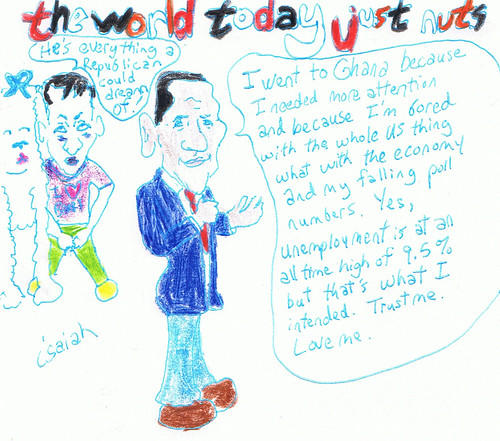
From last night, that Isaiah's The World Today Just Nuts "The Republican Dream."


The Republican Dream

As most of you know, Mike is my son. He has been noting his intense love for sushi of late (Ann's subbing for him this week, he's on vacation). And that's resulted in seven e-mails about sushi.

Yes, I love sushi. No, I can't make it. I wish I could. I tried three times with tuna and it just didn't work.

If you can afford it, sushi is wonderful this time of year because it's served cold (actually raw).

Like my son (and his father and his oldest brother), I prefer sushi in a sushi roll. And Mike's least favorite isn't peanut. Everyone keeps e-mailing that but he wrote it but was wrong. The one he hates is the cream cheese sushi roll. I doubt he's ever eaten a peanut sushi roll. When he comes back, I'll tell him the one he hates is cream cheese. Tony's father loves that. (Tony is Mike's best friend and his father is my husband's best friend -- both sets of guys went to school together all the way from K through 12 and Tony and Mike went to college together as well.) Mike had sushi three or four times senior year (he'd never try it before) and then, that summer, Tony's father brought some over. Cream cheese. Mike dove in and regretted it.

California is his favorite sushi roll and that's crab, rice, avocado, cucumber, giner and additional ingredients. My favorite is any, even cream cheese.

Is sushi good for you?

As good as fish is for you.

And mercury means we have to watch our fish intake.

But a sushi roll is nice on a hot summer day. If you're trying to stretch it, serve it with a salad or some fresh summer vegetables so that the sushi is part of the meal and not the meal itself.


This is C.I.'s "Iraq snapshot" for Monday:

Monday, July 13, 2009. Chaos and violence continue, churches are the new targets in Iraq, BBC airs a documentary exploring the assualts on Iraq's LGBT community, Mike Mullens visits Iraq, ABC's Bob Woodruff covers it, and more.

Starting with war resistance. Last week in the US, a group of activists rallied for US war resister Kimberly Rivera, the first female resister to publicly seek asylum in Canada, at the Canadian Consulate in San Francisco. They gathered petitions and rallied outside at noon before presenting the petitions.
Bill Carpenter (Indybay Media) offers a report with video. David Solnit, co-author with Aimee Allison of Army Of None, explains in the reception area that they have signatures for Kimberly "who is a US soldier who's facing deportation" from Canada. From the video, I believe that's Joanne Cherep that approaches them. (I could be wrong.)

David Solnit: Hi. My name's David Solnit, I work with a peace group called Courage to Resist and we have a bunch of folks with peace and human rights groups and we've gathered 6,000 signatures in support of Kimberly Rivera and so we would like to present them.

Except for Adrian Wilson, all present were US citizens. Wilson noted, "I'm a Canadian citizen and I'm here representing unconventional action in the Bay and I just wanted to request that PM [Stephen} Harper grant asylum to any and all Americans who are seeking refuge." Below is the letter 6,000 people signed on to.

Rt. Hon. Stephen Harper, Prime Minister of Canada Minister of Citizenship and Immigration Jason Kenney Please act immediately to stop the deportation of Kimberly Rivera, her husband and their three children by implementing the Canadian Parliament's resolutions to allow U.S. war resisters to stay in Canada. I am writing from the United States to ask that you abide by the House of Commons resolution -- reaffirmed February 12, 2009 -- to create a program to allow war objectors, including U.S. resisters, to apply for permanent resident status in Canada and to cease all deportation and removal proceedings against them. The recent flurry of deportation orders to war resisters, including Kimberly Rivera, and the forcing out of Robin Long, Cliff Cornell and Chris Teske, flaunted Canada's longstanding tradition of providing sanctuary to war objectors. Upon their forced return from Canada to the U.S. military, Robin and Cliff were sentenced to 15 and 12 months imprisonment respectively. Future resisters face even stiffer sentences. When more than 50,000 Americans refused to fight in Vietnam and emigrated to Canada, Prime Minister Pierre Trudeau declared, "[They] have my complete sympathy, and indeed our political approach has been to give them access to Canada. Canada should be a refuge from militarism." On June 3, 2008, the House of Commons first voted to uphold this rich tradition by passing a historic resolution to allow war resisters to apply for permanent residence status in Canada and to halt the deportation of conscientious objectors. In addition to this parliamentary motion, according to a recent poll, nearly two of three Canadians also favor allowing U.S. war resisters to stay. Furthermore, many wonderful Canadians have opened their homes and hearts to U.S. war resisters. I ask that the Canadian government respect the democratic decision of Parliament, the demonstrated opinion of the Canadian citizenry, the view of the United Nations, and millions of Americans by immediately implementing the motion and cease deportation proceedings against Kimberly Rivera, Jeremy Hinzman, Patrick Hart, Dean Walcott and other current and future war resisters.


Yesterday
BBC Radio 5 live broadcast the documentary Gay Life After Saddam. The documentary was supposed to air July 5th; however, the Wimbledon Men's Final ran long and the broadcast was rescheduled. This is a section of the opening:

Aasmah Mir: Since the invasion six years ago a steep rise in sectarian violence has claimed thousands of victims throughout the country but this could just be the tip of the iceberg because murders and attacks against the lesbian, gay, bisexual and transgendered community are also on the increase but often go unreported. So what is happening to gay people inside Iraq? We've spoken to a range of people -- to those still inside the country and to those who fled to different parts of the world. The names of victims appearing in this program have been changed to protect their identities. Researchers from the US-based
Human Rights Watch recently spent several months investigating the treatment of gay people in Iraq.

Scott Long: Today we're going to look at a new issue for us --

Aasmah Mir: The director of the organization LGBT program, Scott Long, outlined some of their findings at a briefing in New York.

Scott Long: I'm going to start by reading a testimony, or part of a testimony, from a man we spoke to who was 35-years-old. He actually developed a severe speech impediment from strain and grief. This is what he told us: "It was late one night in early April and they came to take my partner at his parent's house. Four armed men barged into the house. they were masked and wearing black. They asked for him by name. They insulted him and they took him in front of his parents. He was found in the neighborhood the day after. They had thrown his corpse in the garbage, his genitals were cut off and a piece of his throat was ripped out. Since then, I've been unable to speak properly. I feel as if my life is pointless now. I don't have friends other than those you see. For years, it's just been my boyfriend and myself in that little bubble by ourselves. I have no family now. I can't go back to them."
Aasmah Mir: Back in Britain, I went to see asylum seeker Ali Hilli who runs a group called
Iraqi LGBT.

Aasmah Mir: Hello Ali.

Ali Hilli: Hello Ashram, how are you?

Aasmah Mir: I'm fine thank you. How are you?
Ali Hilli: Good thank you.

Aasmah Mir: Thanks very much for talking to us.

Aasmah Mir: While I was with him, Ali showed me some of the shocking video evidence of torture his group has been collecting. The images he showed me concerned attacks on transsexuals

Aasmah Mir: People were -- had their heads shaved. In this video we see one of the victims, his name is Ali also, he was a member of our group in Najaf, a trans person lived all his life as a transwoman. They took him away. They had his head shaved. And they distributed this video everywhere in Iraq and we still don't have an idea

Aasmah Mir: And that's what we can actually see right now, he's sitting on a stool, dressed in female clothes, long hair and someone is shaving his head.

Ali Hilli: Yes and uh it's so degrading.

Aasmah Mir: Yeah. How do you feel when you watch this kind of video because obviously you probably see a lot of it. This is the first time I've seen anything like this and, you know, obviously I'm quite shocked by it. But you, you must see this stuff all the time. Do you still feel shocked by it or are you almost becoming -- getting used to it in a kind of way?

Ali Hilli: No, I will never get used to atrocities against humanity. If I see the video for the first time, I'm quite shaken because the only thing that I-I afraid to catch is the moment of death. This is what I-I don't want to see in my life. I-I can - I can bear anything, I can accept anything but to kill a human? I just can't.

Aasmah Mir: We were granted exclusive access to one of the so-called safe houses set up and funded and managed by the London-based Iraqi LGBT group. On the outskirts of Baghdad, in an anonymous street behind heavily curtained windows we found Kassim a man in his late thirties. Kassim describes himself as a woman in a man's body. He's had a lifetime of trouble coming to terms with his gender identity. Kassim's been the victim of violence on several occasions most recently earlier this year

Kassim: One day, um, someone stopped his car by me and he said "Taxi" and I said, "Why? Why taxi?" Where are you going? And I said I was going to this certain place. He took me to an empty house and put a white blindfold on my eyes and then put a gun to my head and I said, "Just give me a time to pray to God before you kill me." And he said, "I won't give you time to pray." And he threatened me and I wasn't moving because I was afraid that he would kill me with the gun and then finally he said, "Okay, I'll let you go for this time but your day will come where you will die

Aasmah Mir: Amil's a young Iraqi man whose seeking asylum in London. A gay friend of his was killed by extremists in Iraq.

Amil: I used to have a friend, he was student with me and they find out he was gay and they kill him and they chop him like a -- like a lamb or I couldn't or I can't - I can't hardly say because it was really awful. They kill him and they chop it him and they put him in front of the institute, the one I was studying, to show and to scare the people to not be gay or homosexual.

Aasmah Mir: Most shocking of the recent reports to emerge from Iraq is a form of torture used on gay men involving glue. Hossein Alizadeh is the Middle East and North Africa researcher for the
International Gay and Lesbian Human Rights Commission

Hossein Alizadeh: The most horrendous form of torture that I have heard and seen is what happened during March and April in Iraq. Members of the Iraqi Shi'ite militia al-Mahdi group, they went around posted lists, names of the people who were supposed to be gay and when they arrest them they basically use glue to shut down their digestive system -- the anus. Others who managed to escape go to the hospitals and the hospitals refuse treatment to those people because, again, they look gay or they're perceived to be gay. So we had numerous cases -- I can tell you about fifty or sixty cases I've heard -- that have been tortured in that way.

Aasmah Mir: Rasha Moumneh is the Middle East researcher for Human Rights Watch

Rasha Moumneh: You know some of the gay men have actually talked about internet entrapment, a lot of men would be kidnapped, blackmailed for money. We've talked to people whose partners have been killed in the most brutal of ways.

Aasmah Mir: And it appears that it is not just people who are gay, bi or transsexual who find themselves the target of violence

Ali Hilli: Anyone who's gay, who looks like gay, or have an effeminate behavior, certain Western dress, we've heard of so many examples of people who were, they were even married with children

Aasmah Mir: There seems to have been an increase in violence in recent months but according to the London-based Iraqi LGBT the killings and torture go back a long way. They claim more than 600 people have been executed since 2003.

Ali Hilli: There are so many other areas like villages, little towns, also big cities, we can't have people reach to or investigate about incidents. Also sometimes security situation is quite very complicated, people can't travel often to check or find out what's happening in certain areas. So I believe the number is far more higher than 600.

Aasmah Mir: Gay people are seeking sanctuary from the violence in Iraq in all parts of the world. At a secret location by the banks of the Seine in Paris we met Omar a twenty year old gay man who just weeks earlier had been facing death in Iraq. A small, slightly built young man, who looks younger than his age, told us his story. At times clearly traumatized.

Omar: I was arrested and I was in retention and there I found five other gay persons. We suffered torture. There was the electrical way -- to use electricity to torture us. And there's a position where my head is down through my legs -- and my head is down, it's something horrible. While you have another mean of torture using the belts -- you cannot imagine -- a normal person cannot imagine such torture.

Aasmah Mir: I'm Aasmah Mir and you're listening to Gay Life After Saddam on BBC Radio 5 live. So what was life like for gay, lesbian, bisexual and transgendered people before the fall of Saddam Hussein

Scott Long: There was no possibility of leading a particularly public gay life. There are reports from Amnesty International that 2002 as Saddam was attempting to sort of shore up his Islamist credentials, before the invasion, he passed decrees mandating the death penalty for prostitution and for homosexual conduct. We haven't actually seen those decrees and we can't confirm what they contain.

Aasmah Mir: This Iraqi student who wishes to remain anonymous now lives in New York

Anonymous: I had a pretty, you know, reasonable gay lifestyle under the table -- in terms of, you know, circle of friends, gatherings, get-togethers, we'd get together at homes. Before the war, there were a couple of bars, a couple of clubs that on weekends are pretty much publicly gay and everybody knew about it and we used to go and hang out there and that's fine as long as we don't take that out in the streets.

Aasmah Mir: Ali Hilli was a young gay men in Iraq during the 1990s. He has fond memories of the underground gay scene that flourished without much interference in Saddam's Baghdad.

Ali Hilli: Well we had - we had lots of theater actually plays that we were -- people always have to refer to the gay character which is always taken as a sense of humor in shows. We used to go to -- to see lots of theaters and plays. I don't know, for some reason there is always a gay character in these plays and I quite like it because I know some of the actors who are really gay themselves and we enjoy it because they really make the most of it. They camp it up. And there were lots of gay famous singers.

Aasmah Mir: Kassim remembers a better life under Saddam .

Kassim: Life was good, everything was okay. There were clubs, cafeterias and we could choose where we sat. We could choose any place to sit and meet other gays and frankly compared to the current situation the times under Saddam were much better.

Aasmah Mir: Haider is an Iraqi seeking asylum in England. He's been living in Huntersfield. He left Iraq shortly after the US invasion six years ago.

Haider: If you respect yourself and live and you don't cause any problems nobody is going to kill you we didn't hear of anybody being killed because of his sexuality in Saddam's regime. Now after that, everything got worse, everything got fluctuated. I fled from Iraq in 2003 because of one of the worst experiences I've had in my life. I was kidnapped for 9 days, they took me in a small car and they send me about to a place about half an hour. I was. I was eye-folded, they call it. [. . .] on the border of Baghdad. One of the officers there, he raped me. And then he said "if you're going to tell anyone from the rest of the gang, I will kill you directly." I was scared. Just a one meal a day which is not enough. They were always telling us that they were going to kill you.

If you missed it
you have six days to listen online and note that first five minutes of the podcast are headlines and the program starts around 5:42 into the podcast. The next section is where ignorance is really flaunted as 'average' Iraqi men 'explain' 'reality.' Such as it's wrong to have sex with a guy who is a man -- as opposed to a guy who is a woman? You'll hear non-stop ignorance and hatred in that section. After that the issue of responsibility for the violence is raised and then is there a role for the US, UK, etc. It's a powerful program and those who are able to stream it should.

Violence swept through Iraq over the weekend and a new feature,
reported by Iran's Press TV, was the targeting US Ambassador Chris Hill with a roadside bomb in Dhi Qar. Jomana Karadsheh (CNN) explains, "The Shiite Arab-dominated province was among the first handed over to Iraqi security forces, and was the scene of periodic clashes between Iraqi security forces and a militia loyal to anti-American Shiite cleric Muqtada al-Sadr in 2007." Aamer Madhani (USA Today) adds, "A USA TODAY reporter was traveling in a separate U.S. convoy a few minutes behind Hill's in Nasiriyah, a relatively peaceful city where Hill had just finished meeting with local political leaders." No one was reported wounded or killed in the bombing and no one should bother to even think about if if the US State Dept's reaction is any clue. In a shameful press briefing today Ian Kelly, State Dept spokesmodel, never raised the issue and an increasingly disinterested press corps never asked. Iraq's not one of their 'issues' apparently and Kelly seems to forget that Chris Hill is under the State Dept umbrella.

The bombing targeting Hill wasn't the only one but the State Dept press corps doesn't give a damn about Iraq and Ian Kelly couldn't find it with two hands and a flashing lights illuminating its borders. So the new 'hot' target in Iraq was yet another issue the State Dept didn't tackle. It needs to be noted that this administration repeatedly pushes the previous one's talking point about lack of progress on Iraq's political scene. So why isn't that asked of at each State Dept briefing? Because the reporters just don't give a damn.

Saturday
Mohammed al Dulaimy (McClatchy Newspapers) reported two Baghdad bombings which damaged a church. By the following day, a pattern would emerge. Liz Sly (Los Angeles Times) explains that "six bombs exploed outside churches around Baghdad" on Sunday "killing four and sowing fears among the country's dwindling Christian minority that they may be subject to a fres round of persecution now that U.S. forces have withdrawn from Iraq's cities." Michael Ware (CNN -- link is for video report, not the text on the page) reported on the bombings:

Naamua Delaney: Michael you also talked about the mass exodus of Christians from Iraq. How many are left at this point? Michael Ware: Well that's very difficult to say. There's no precise figures on what was originally the Christian population in this country; however, most people seem to agree it was around a million Christians in Iraq. Most people now seem to agree that anything from 600,000 to 800,000 of that million have fled. Indeed we know that just say last October there were reports that in the northern city of Mosul which is one of the last urban strongholds of al Qaeda in Iraq as many as a thousand Christian families left the city and left the country at that time after they faced a threat from Islamic militants to convert or to die.

From summer to fall of 2008, Iraqi Christians in and around Mosul were targeted. Yesterday's attack on Iraqi Christians in Baghdad was the most visible attack on Iraqi Christians in months; however, it is a slow and steady trickle of weekly and daily attacks that have gone on since the start of the illegal war.
Steven Lee Myers (New York Times) observed that Sunday's "worst attack" was when "a car bomb exploded just before dusk outside the Church of Mariam Al-Adra, or the Church of the Virgin Mary, part of the Chaldean Catholic Church in Iraq, in central Baghdad. The blast, which reverberated across the city, damaged the church and scorched cards near a park on Palestine Street. The blast killed and wounded Christians and Muslims." Doreen Abi Raad (Catholic News Service) reports, "Chaldean Auxiliary Bishop Shlemon Warduni of Baghdad, Iraq, had just finished celebrating Mass at Our Lady of the Sacred Heart Chruch and was talking to parishioners in the courtyard. Moments later, while he was in his office, a bomb exploded on the road that runs alongside the church." Doreen Abi Raad quotes Bishop Warduin stating, "We had been praying for peace during the Mass. [. . .] all the little children (had been) praying in the church. Then they ran outside to see the death, the destruction, to see the war. It was hell. We cry: Why? Why? What is our fault? That we are Christians?" Pope Benedict XVI has called out the assaults on Sunday. L'Osservatore Romano (Italian article, and note the photo the charred car outside the church) reports that the Pope states he "prays for a conversion of the heart of those responsible for the violence and encourages the authorities to do all that is possible to promote peace for all of the Iraqi population." The report notes that since the fall of Saddam's regime, Iraq's Christian community has been the target of a series of attacks with August 2004 being the most serious when there were four attacks in Baghdad and two in Mosul which led to at least ten dead and fifty wounded. October 16, 2004 saw five attacks on houses of worship in Baghdad and surrounding areas. Under Saddam, the report states, the Christians in Iraq enjoyed safety and a reletaive freedom and some held important positions in the government like Tareq Aziz who was the Deputy Prime Minister prior to the start of the illegal war. (Since Marach of this year, he has been serving a fifteen year prison sentece. He had been held by the US military since 2003. In 2007, Cardinal Emmanuel Delly made a Christmas plea for his release.) The most high profile assault on a single Christian individual was probably the kidnapping and murder of Archbishop Paulos Faraj Rahho. From the March 13, 2008 snapshot:

Archbishop Paulos Faraj Rahho is dead. He was leaving the Catholic Church in Mosul when he, his driver and two others were stopped on
February 29th and the Archbishop was kidnapped while the three others were shot dead. Throughout the kidnapping, Pope Benedict XVI has issued mutliple appeals for the Archbishop to be released. The kidnappers had requested a ransom and then increased the amount they were asking for. After that contact appeared to break off. Reuters reports that the Archbishop's corpse was discovered in Mosul today "half-buried in an empty lot" and "Police said it was not clear whether Rahho, 65, had been killed or died of other causes. He appeared to have been dead a week and had no bullet wounds, police at the morgue in Mosul said. He was dressed in black trousers and a blue shirt." AP reports, "After two weeks of prayers and searching, officials at the archbishop's church received a phone call from the kidnappers on Wednesday, informing them that he had died and where he was buried, Monsignor Shlemon Warduni, the auxillary bishop of Baghdad, told The Associated Press." Spero News notes, "In a letter to the Patriarch of Babylon of the Chaldeans, His Beatitude Emmanuel III Delly, Cardinal [Francis] George called today's killing 'callous' and one which 'demonstrates the particularly harsh realities faced by Christians in Iraq and the lack of security faced by all Iraqis'." Chaldean.org notes, "The Chaldean community around the world stand numb and in disbelief as news of Archbishop Paulos Faraj Rahho of Mosul is dead. Outcry from world leaders swayed no influences as fanatical terrorists proved once more that no women, children, medical providers, and now spiritual leaders are safe from their killing spree." They also note that the ransom requests led to requests by the Church to speak to the the Archbishop and that's what led to their being informed he was dead and "had been dead for at least five days before his body was found this morning by some members of the Church, following information provided by the kidnappers themselves." Frances Harrison (BBC) notes, "Archbishop Paulos Faraj Rahho is thought to be the highest-ranking Chaldean Catholic clergyman to be killed in the violence in Iraq." March 11th, US House Rep Jeff Fortenberry raised the kidnapping of the Archbishop in an open hearing (by two subcommittees, click here).

Today Iraq attempted to 'respond' to the bombings. There's only one response ever, the same response Nouri's done over since being installed by the US in 2006: crackdown.
Aseel Kami, Tim Cocks and Richard Balmforth (Reuters) explain Mosul is now under curfew while, at present, nothing different is taking place in Baghdad. CNN notes that another church has been bombed today, this one in Mosul (the curfew doesn't appear to have helped, now did it?) with three children (possibly more) left injured. Nada Bakri (Washington Post) reports that while Mosul is under crackdown, security has been "tightened" in Baghdad while Tilkaif and Hamdaniyah have a car ban. The United Nations Secretary-General's Special Representative for Iraq, Ad Melkert, stated today that, "This campaign is aimed at terrorizing vulnerable groups and preventing the peaceful coexistence of different religious groups in what is one of the world's cradles of religious and ethnic diversity." Sahar Issa (McClatchy Newspapers) notes that the bombing today in Mosul was between a church and a mosque and that three boys were wounded and a Baghdad roadside bombing left three police officers and four civilians injured.

Meanwhile
ABC News notes that Bob Woodruff has returned to Iraq and the "first report will air tonight on World News with Charlie Gibson". In January 2006, Bob Woodward was co-anchor, with Elizabeth Vargas, of ABC's World News Tonight. A roadside bombing severely injured him and he had a very difficult recovery. David Zurawik (Baltimore Sun) explains Woodruff's report won't air tonight due to a sandstorm and that his first report is now expected to air on Tuesday night. Brian Stelter (New York Times) notes Woodruff is with the press corps covering Adm Mike Mullen's trip. Bob Woodruff's recovery was rightly news and his return trip to Iraq is as well. However in the bulk of the reports (I know of at least twenty that we're not linking to) the focus is on Bob Woodruff who, honestly, won't have much time to absorb the trip until he returns due to his schedule (and temperament). If reporters were attempting to cover the stress right now, I would assume the person to call would be Lee Woodruff, author most recently of Perfectly Imperfect: A Life in Progress, who is no doubt proud of her husband but would understandly be more than a little ill at ease as she waits for his return. Again, Bob Woodruff's first report is scheduled to air Tuesday evening on ABC World News Tonight.

Again, he is part of the press corps traveling with the chair of the Joint Chiefs of Staff Mike Mullen whom,
Andrew Gray (Reuters) reports is grounded in the oil-rich city of Kirkuk due to the sandstorms and that he has met with leaders in Kirkuk. Mullen summed up the 'interaction' thusly: "My message to them today was: we're leaving and you'd better figure it out." On the issue of Kirkuk, Waleed Ibrahim (Reuters) reported yesterday that the status of Kirkuk "is now seen as the leading long term threat to Iraq's stability as sectarian violence dies down" and that Kirkuk does not appear likely to be getting a vote anytime soon and cites the Speaker of Parliament, Ayad al-Samarai, declaring that instead of open election, Arab and Turkmen MPs are advocating for a number of seats set aside for each ethnic group in the city.

Moving over to England,
Matthew Weaver (Guardian) notes that Iraqi Baha Mousa's death at the age of 26 while in British custody in September 2003 is the subject of a public inquiry in England which began today and that, "A central issue of the inquiry is why five 'conditioning techniques' -- hooding prisoners, putting them in stress positions, depriving them of sleep, depriving them of food and water, and playing white noise -- were used on Iraq detainees. The techniques, inflicted on IRA suspects, were banned in 1972 by then prime minister, Edward Heath." The Telegraph of London offers that Baha "was beaten to death" while in British custody, "sustaining 93 separate injuires, including fractured ribs and a broken nose." The Telegraph also notes that the inquiry was shown video of Corporal Donald Payne yelling and screaming, "shouting and swearing at the Iraqis as they are force to main painful 'stress position'." Julian Rush (Channel 4) offers a video report of the hearing thus far and what the inquiry is supposed to explore over the next year. BBC explains the Sir William Gage led inquiry will explore four segments:• The history of "conditioning" techniques, like hooding, used by UK troops while questioning prisoners from Northern Ireland in the early 1970s to the invasion of Iraq in March 2003 • What happened to Mr Mousa and other Iraqi detainees • Training and the chain of command • Events since 2003 and any recommendations for the future


Moving to the US, last week, the
US army released their latest suicide data (for the month of June). Gregg Zoroya (USA Today) reports this morning, "Army commanders are failing at the day-to-day task of monitoring troubled young soldiers in their barracks back home, which is helping push suicides to record numbers, the head of the Army's suicide task force [Brig Gen Colleen McGuire] says." James Dao (New York Times) tracks Iraq War veteran Damian J. Todd's attempts to get his claims filled by the VA in order to put a human face on the non-stop, never-ending delays by the VA. Dao notes that the VA's unprocessed claims are "now over 400,000, up from 253,000 six years ago, the agency said." Actually, they're a lot higher. The June 25th snapshot notes that day's House Veterans Affairs Subcommittee on Economic Opportunity hearing on the Post-9-11 GI Bill which requires new payments starting August 1st. [If you qualify or think you may for the new education benefits, you can refer to the VA's GI Bill website as a resource. For those with limited internet access or who would prefer the human interaction, the toll free number is 1-888-GI-BILL-1 or 1-888-442-4551. The Veterans of Foreign Wars (VFW) has a webpage that gives you a historical overview and also allows you to locate a VFW service officer who can assist veterans with the application process.] The VA's Director from the Office of Education Service Keith Wilson testified that, due to the number of applications which had come in up to that point, there might be a last minute crunch of applications as people rushed to put their paperwork through in order to qualify for the fall semester. Dao notes, "Veterans advocates say the actual backlog is nearing one million, if minor claims, educational programs and appeals of denied claims are factored in."

As Winona says to Ethan in Reality Bites, "Where were you?" To draw attention to Iraq on the sixth anniversary,
Rebecca instituted a number of community roundtables in the weeks leading up to the anniversary. They took place each Friday night and were posted at the sites of all participating. One week, Rebecca led us in an additional roundtable. "Selling out the women of Afghanistan," "Afghanistan," "Afghanistan women get forgotten""Afghanistan roundtable," "US designates Gulbuddin Hekmatyar a Terrorist," "afghanistan roundtable," "Afghanistan," "Afghanistan in the Kitchen," "Talking Afghanistan," "The Afghanistan Roundtable," "Roundtabling Afghanistan," "Friday night movie post on Tuesday," "Afghanistan roundtable," "Iraq and Afghanistan," "Afghanistan," "Ron DLC Kirk," "Iraq, Hillary, Isaiah, etc" and "Anti-feminist Barack Obama." From the opening of that roundtable:

Rebecca: [. . .] Why a roundtable? Why now? Middle of the week when we all have things to do. We're doing this on Ava and C.I.'s dinner time, for example. Kat's as well but she's not planning on going back out and speaking about Iraq tonight. Kat, Ava and C.I. are on the road -- with Wally of
The Daily Jot -- speaking out against the illegal war in and on Iraq. Ruth's been taking care of her grandson all day, Trina's been taken care of her granddaughter, I've been taking care of my daughter, Betty worked all day and has three children, Dona was in classes all day, Elaine was seeing patients all day, Marcia was working hard -- and almost had a heart attack, as Ava and C.I. always say, "we'll get to it." The point being -- and I hope I didn't leave anyone out -- we're all busy. We all have other things to do. Ava and C.I. are taking notes, therefore unable to really eat dinner. Elaine said she'd type this up and she's tired. We're all tired. But we're doing a roundtable because it's become necessary. On Sunday, Little Barry Obam-bam could be found in the New York Times floating diplomatic ties between the US and the Taliban. That's what it was, get serious. Third Estate Sunday Review addressed it with "Editorial: Ms. magazine gets punked" and that was written by Jim, Jess, Wally and Ty, who aren't with us, and Dona, Ava, C.I., Kat and Betty, who are with us. It's only getting worse as the week continues, Little Barry's Big Plan to make out with the Taliban. I understand he's going to give it up for them, lose his cherry. But I'm going to toss to Marcia to explain how it just got out of control today. Marcia?
Marcia: As I explained to Rebecca, I was at work when my boss starts screaming for me. At the top of her lungs. I didn't think it was financial -- example, "We're closing!" And my own work hadn't been any problem. Plus my boss isn't a screamer. So I hurry into her office convinced she's just learned that one of her parents have died or that she's got only a few months to live or something. She was on the phone with a friend who had called to tell her about this "disgusting radio show" and how they were pushing the Taliban as a good thing. My boss couldn't believe it but then her friend was trying to remember the name and couldn't.. Finally, she remembered the name of the host, Amy Goodman.
I include all that because (a) if anyone wants to go to town on the highlight we're about to note, do so with my blessing and (b) we need to realize that the time to speak out was in March, not July. And if you're only now speaking out, you should be speaking out even stronger. And if you can't mention Barack -- you know I'm damn tired, DAMN TIRED, of these closeted Communists. I don't know why they love Barry and I don't know who they think they fool by being "out" in political circles but closeted on air and in print. I guess we're supposed to believe Pacifica's just an oasis of "independent" voters? So cowardly craven Sonali Kolhatkar finally wants to speak up for Afghanistan women. FINALLY. And don't give me that s**t about how she's spoken out before. Her ass has been silent since Barack chose to get in bed with the Taliban. She hasn't said a damn word until this month.
With Mariam Rawl, she offers (at ZNet):

As humanitarians and as feminists, it is the welfare of the civilian population in Afghanistan that concerns us most deeply. That is why it was so discouraging to learn that the
Feminist Majority Foundation has lent its good name -- and the good name of feminism in general -- to advocate for further troop escalation and war.

On its foundation Web site, the first stated objective of the Feminist Majority Foundation's "Campaign for Afghan Women and Girls" is to "expand peacekeeping forces."

First of all, coalition troops are combat forces and are there to fight a war, not to preserve peace. Not even the Pentagon uses that language to describe U.S. forces there. More importantly, the tired claim that one of the chief objectives of the military occupation of Afghanistan is to liberate Afghan women is not only absurd, it is offensive.

Waging war does not lead to the liberation of women anywhere. Women always disproportionately suffer the effects of war, and to think that women's rights can be won with bullets and bloodshed is a position dangerous in its naïveté. The Feminist Majority should know this instinctively.

Here are the facts: After the invasion, Americans received reports that newly liberated women had cast off their burquas and gone back to work. Those reports were mythmaking and propaganda. Aside from a small number of women in Kabul , life for Afghan women since the fall of the Taliban has remained the same or become much worse.

Under the Taliban, women were confined to their homes. They were not allowed to work or attend school. They were poor and without rights. They had no access to clean water or medical care, and they were forced into marriages, often as children.

Today, women in the vast majority of Afghanistan live in precisely the same conditions, with one notable difference: they are surrounded by war. The conflict outside their doorsteps endangers their lives and those of their families. It does not bring them rights in the household or in public, and it confines them even further to the prison of their own homes. Military escalation is just going to bring more tragedy to the women of Afghanistan .
You can agree with their essay if you want to be STUPID. If you want to be a FOOL. Feminist Majority Foundation is making a fool of itself, no question. And we've called them out (and I know Eleanor Smeal but that never stops me from calling her out). But what a ridiculous piece of trash column from Sonali. Feminist Majority Foundation is the ultimate target?

Really? You want to play that? Are you telling me that Eleanor Smeal is directing the Afghanistan War? Strange, I thought it was Barack Obama. You know, the man your closeted Communist won't call out for reasons that you need to explain to your listening audience. Sonali, you're a damn joke and you made yourself one. This column where you finally, FINALLY, speak out for Afghanistan women is so damn weak and pathetic it's as if a small toddler wrote it with a crayon. Grow the hell up, you political closet case, you're a damn embarrassment for yourself and others and I don't have the time and the women of Afghanistan damn sure don't have the time. You either grow the hell up and learn to call out the president directing this illegal war of aggression or shut your damn ass because you're not helping anyone. You're just embarrassing yourself. What an idiot. What a coward. What a fool. Closets are for wardrobes, dear. Here's another tip, when you're calling out people getting cozy with the wrong side in Afghanistan and doing it four months late, you need to write a lot more strongly. Get off your knees and stand the hell up, you embarrass us all.

Ron Jacobs hides in no political closet.
At Dissident Voice, he raises an important issue today:

Should the US antiwar movement be attending rallies sponsored by the National Endowment for Democracy (NED) claiming to support the opposition movement in Iran? According to the group Stop War on Iran, this is exactly what United for Peace and Justice (UFPJ) and other antiwar groups are doing. If so, are they really supporting the leftist and progressive elements of that opposition or are they naively providing cover for those in the United States power elites who would love to see a regime friendly to Washington ruling in Tehran? Recently, UFPJ urged its members to attend rallies called by a group that goes by the name of United for Iran on July 25, 2009. While I believe the intentions of the antiwar organizations calling on folks to join these protests come from a genuine desire to see an end to the Tehran government's repression, the fact that some of the Iranian dissident groups in Iran and in exile take their money and guidance from the NED and other US-propaganda operations compromises the antiwar groups' position.
An even closer connection to the NED funds is that of the apparent US organizer of the United for Iran rallies, Hadi Ghaemi. Mr. Ghaemi is is the director of the International Campaign for Human Rights in Iran. This group is a project of the Dutch Foundation for Human Security in the Middle East. More important as regards his NED connection is Ghaemi's role as a former board member of the National Iranian American Council, which has received over a quarter million dollars in NED grants. While this is not an indictment of the desire for greater freedoms in Iran expressed by Ghaemi and his organization, one would think these connections would give pause to a US antiwar group whose leadership knows only too well the role groups funded by the NED and other US special funds played in the period leading up to the 2003 invasion of Iraq.


iraq
aimeee allisondavid solnit
jomana karadshehcnn
aamer madhani
mcclatchy newspapers
mohammed al dulaimy
liz slythe los angeles times
cnnmichael warenaamu delaneythe new york timessteven lee myers
the washington postnada bakribbc news
david zurawikjames daomatthew weaverthe guardianthe telegraph of londonjulian rushgregg zoroyausa today
ron jacobs

Friday, July 10, 2009

Baked tuna casserole

Latrice e-mailed to say she always enjoyed her mother's tuna casserole but when she made it for her kids, they took one bite and refused to eat any more. What was she doing wrong?

I asked her to go through it step by step and we discussed it and she's not doing anything wrong.

We took a guess that the 'soft' or 'liquid' nature of the casserole (due to the cream of mushroom soup) might be the problem.

Baked Tuna Casserole
package of noodles
1 to 2 cans of tuna
1 can of cream of mushroom soup
salt
pepper

Cook noodles of choice according to package directions and drain. Place noodles in a bowl, add tun, add soup. Stir contents of bowl. Add salt (if desired) and pepper. And stir. If you'd like to make it cheesy, you can add shredded or grated cheese here and stir.

Spoon contents of bowl into a baking dish and put into a 350 degree oven for 25 to 30 minutes.

Remove from oven and serve.

Cheese can be added, stirred and then added on top after the contents are in the baking dish.

You can also chop a celery stick or two or a carrot stick or two (or grate a carrot) and add it to the bowl. (This would be done "to the bowl" meaning before cooking.)

It's a simple recipe and it's inexpensive. And? Latrice's kids ate it and liked it.

While I was on vacation, Barack's stimulus package worked and the economy grew by leaps and bounds. Not.

The economy's worse than before and as we pointed at Third (I worked with them on that one) back in 2008, if Barack's stimulus fell (and we thought it would), it would be incredibly difficult for him to ask for another. We were already, by then, seeing outrage over Bully Boy Bush's stimulus (non-stimulus) and you could sense a very real reluctance, after the bank bailout, on the part of American tax payers to get behind an auto bailout.

While I was on vacation, we hit a record job loss. Now the public's registering their reaction to that news from last week:

US Economy: Consumer Sentiment Falls on Job Losses
Bloomberg - Shobhana Chandra, Bob Willis - ‎11 hours ago‎
A shrinking deficit signals trade will add more to US gross domestic product as exports to emerging economies such as Brazil increase. ...
Sweet & sour: Economists upbeat on economy; consumers, less so Daily Finance
July 10, 2009: Highlights Of Low Points In US Economy AHN
all 156 news articles »


And if you're counting on the stock marke to come to the rescue, well forget it.

Dow, S&P 500 in fourth weekly fall as economy weighs
Washington Post - ‎2 hours ago‎
... conference have spent as much time discussing how to reconfigure business models disrupted by the Web as they have worrying about the weak economy. ...
Stocks open lower as earnings jitters increase The Associated Press
Dow, S&P 500 in fourth weekly fall as economy weighs Reuters
Stocks End Week Down Inside Self-Storage
The Associated Press
all 706 news articles »
CVX - OTC:LEHMQ


Barack's stimulus did nothing. And we were saying that would be the case even before Paul Krugman sounded alarms. Today Krugman wants to look for the silver lining.

There is none and Paul Krugman's being a fool at a time when we can't afford it.

Paul thinks that Barack's going to get honest with the American public and say he made a mistake. Really? After his correcting Joe Biden when Biden admitted that was the case on Sunday?

Barack's not going to get honest. He's spent the last months doing nothing but blaming the previous administration and claiming he had no idea what he was inheriting.

Bull. In September, the whole country knew. Most of us knew before then. But by September 2008, it was obvious.

The election was in November 2008.

Barack had plenty of time to 'adjust' to the non-breaking news.

He chose not to.

He chose to be the Corporatist War Hawk we warned you he was.

We warned you. Not Democracy Now! Not Naomi Klein. Not The Nation. Not The Socialist Review. Not Howard Zinn. Not Anthony Arnove. Not The Progressive. Not Barbara Ehrenreich. Not William Geider. Not Naomi Wolf.

Back then, we were lonely voices of sanity in a sea of zombies.

And Paul Krugman does no one any favors by 'addressing' the economy via his fantasies. Stick to the numbers, Paul, they've never failed you.

This is C.I.'s "Iraq snapshot" for Friday:

Friday, July 10, 2009. Chaos and violence continues, war resister Robin Long is out of the brig, the New York Times backs Nouri so much they not only attack the Kurds but they also play dumb about a DC meet-up between Iraq and neighbors that the White House is attempting to set up for later this year, a House Armed Services subcommittee questions the budget numbers, and more.

Starting with war resistance.
Robin Long has no regrets. John Wilkens (San Diego Union-Tribune) quotes him declaring today, "I wouldn't do anything differently." Tony Perry (Los Angeles Times) reports Robin Long was released from Miramar Marine Corps Air Station's brig yesterday "after serving 12 months of a 15-month sentence." Long is a war resister who self-checked out and went to Canada where he attempted to be granted asylum. Not only did that not happen, he was imprisoned and whisked across the border back to the US in violation of his rights and those of his child -- his child is a Canadian citizen.

Today Robin held a press conference and Wilkens covers it noting Robin stated he would continue speaking out and that "[. . .] I had to do what I felt was right."
The Will to Resist: Soldiers Who Refuse to Fight in Iraq and Afghanistan. is the latest book by independent journalist Dahr Jamail. The US Socialist Worker provides an excerpt from the opening of the new book:

The environment in the United States today is not one that can support and sustain a GI resistance movement of significant proportions, giving it enough power to directly affect the foreign policy of the country, as it did so effectively in the Vietnam era. There is much in the military to prohibit a GI resistance movement from growing anywhere near the proportion that helped end the U.S. war in Vietnam. Military discipline is much more repressive than in the past, which makes organizing more difficult. There is less radicalization of the GI movement, as compared to that in the late 1960s and early 1970s; therefore, passive resistance against the command is more common than direct resistance. There is a much lower level of political awareness and analysis among soldiers as compared to that during Vietnam, when there were hundreds of underground newspapers that served to inform troops while criticizing the military apparatus. The all-volunteer military, rather than a draft, is also responsible for stifling broader dissent.
Despite these factors, dissent in the ranks is happening on a daily basis. While overall violence in Iraq has dropped, it is escalating dramatically in Afghanistan, as President Obama begins to "surge" 30,000 troops into that occupation. The overstretched military is in a state of disrepair, full of demoralized, bitter soldiers whose reasons for staying in are based on economics and loyalty to their friends rather than nationalism or patriotism.
These elements, accompanied by the continuing neglect that soldiers experience upon their return home, are driving larger numbers toward dissent.
This is a book about average soldiers and their brave acts of dissent against a system that is betraying them. I decided to focus on the rank-and-file members who actually served in Iraq, rather than those giving the orders from within safe compounds. I believe it is those who have followed the orders who have had to pay the highest price. My main objective in presenting this book is to highlight the reality that oppressed and oppressors alike suffer the dehumanizing effects of military action. For soldiers and war journalists like myself who have lived with this, struggled with PTSD, and reintegrated ourselves into society, a light at the seemingly endless dark tunnel of the U.S. occupations of Iraq and Afghanistan is the possibility of the shifting of these individual acts of resistance into a broader, organized movement toward justice--both in the military and in U.S. foreign policy.

In his latest dispatch, Dahr breaks down the realities about Nouri al-Maliki and his attempts to become the new strong-man:

Let's be clear - Maliki has been supported by the US as the leader of Iraq since his installation. In January 2005, I was in Baghdad for the elections that formed an Iraqi Parliament, which then elected Iraq's first prime minister under US occupation - that man was Ibrahim al-Jaafari. Jaafari wasn't exactly toeing the US/UK line in Iraq, so it wasn't long until then-US Secretary of State Condoleezza Rice and her UK counterpart Jack Straw rushed to Baghdad to
set things straight. Just after their visit, Jaafari was out and Maliki was in. No democracy was involved in this process.
In a recent article titled "
Iraq's New Death Squad" for The Nation by independent journalist Shane Bauer, we are provided with an inside view of Maliki's iron fist, which has come in the form of the Iraq Special Operations Forces.
Bauer writes:
"The Iraq Special Operations Forces (ISOF) is probably the largest special forces outfit ever built by the United States, and it is free of many of the controls that most governments employ to rein in such lethal forces. The project started in the deserts of Jordan just after the Americans took Baghdad in April 2003. There, the US Army's Special Forces, or Green Berets, trained mostly 18-year-old Iraqis with no prior military experience. The resulting brigade was a Green Beret's dream come true: a deadly, elite, covert unit, fully fitted with American equipment, that would operate for years under US command and be unaccountable to Iraqi ministries and the normal political process. The ISOF is at least 4,564 operatives strong, making it approximately the size of the US Army's own Special Forces in Iraq. Congressional records indicate that there are plans to double the ISOF over the next 'several years'."
According to Bauer, control of the ISOF was slowly transferred by US Special Forces to the Iraqis in 2007, but it wasn't put under the command of the Defense or Interior Ministry. Rather, "the Americans pressured the Iraqi government to create a new minister-level office called the Counter-Terrorism Bureau," Bauer writes, "Established by a directive from Iraq's prime minister, Nuri al-Maliki, the CTB answers directly to him and commands the ISOF independently of the police and army. According to Maliki's directive, the Iraqi Parliament has no influence over the ISOF and knows little about its mission."
Untold numbers of politically motivated murders have followed as a result. Regular assassinations and detentions of al-Sahwa (US-created Sunni militia that Maliki had opposed from the beginning) members have been ongoing for years. Last August, the ISOF raided the provincial government compound in Diyala, while backed by US Apache helicopters, and arrested a member of Iraq's main Sunni Arab political party. In December, the ISOF arrested more than 30 Interior Ministry officials who were believed to be opponents of Maliki's Dawa Party. In March, the ISOF arrested a leader of the Sahwa.

As he attempts to become the new Saddam, he does so with the apparent approval and endorsement of the New York Times,
hence Sam Dagher's article today allegedly about the Kurish region and their events but told from a Nouri point of view. Well into the article, primarily an article carping about the KRG's proposed constitution, Dagher notes, "Iraq's federal Constitution allows the Kurds the right to their own constitution, referring any conflicts to Iraq's highest court." Though it bothers Nouri, and apparently the paper, the Kurds can do a new constitution, revamp their old one, do whatever they want and it is their right. The unresolved issue of the oil-rich city of Kirkuk is not presented as having anything to do with Nouri. This despite realities including Damien Cave's June 2007 reporting for the paper when he noted, "The future of oil-rich Kirkuk was left in limbo, with Kurds holding out for a referendum scheduled for the end of this year that they hope will grant them control." The issue of Kirkuk was Constitutionally mandated to be resolved by November 2007 (in the 2005 constitution). Not only that but Nouri agreed to the White House's 2007 benchmarks and those benchmarks included resolving the Kirkuk issue. Dahger ignores all of that but does find time to say the Kruds "defended" attempting "to add all of hotly contested and oil-rich Kirkuk Province, as well as other disputed areas in Nineveh and Diyala Provinces." Are they 'adding' Kirkuk if they've long claimed it? Or are they continuing to stake their claim on Kirkuk? Furthermore, the paper is accepting the boundaries set by the central government and those boundaries have always been in dispute, even in Saddam's time. The areas are disputed on both sides. It's not just the Kurds disputing the boundaries. If you're still not getting how one-sided Dagher's article is, please note that in the print edition of the paper, the article is entitled "Kurds Lay Claim To Land and Oil, Defying Baghdad"; however, Australia's The Age re-runs the article and gives it the more appropriate headline "Kurds' new constitution angers US, Iraq." And certainly Dagher's written reflecting something other than Kurdish goals or interests. Apparently those aren't topics to cover . . . even in an article apparently about the Kurdish region. Al Hurriyet notes that some are trying to state that the northern region of Iraq would be better off with Turkey -- please note that 'some' includes those Americans who lied/spun/cheerleaded the US into Vietnam, some of the same losers (including Katty-van-van's deadbeat father) who were part of the "American Friends of Vietnam" -- a front group which, starting in 1955, began openly advocating for US 'intervention' in Vietnam via lies, trickery and deceit.

The New York Times is so busy shining on al-Maliki, they forgot to tell you about his flare up with US Vice President Joe Biden.
Salah Hemeid (Al-Ahram Weekly) explains the paper only "alluded" and didn't explain but Biden issued a call for bringing the Ba'athist back into the political process. Nouri's response was to issue public statements such as this one through his spokesperson "the government will never talk to those whose hands were stained with blood". Publicly stated. Somehow the paper missed that. Somehow the paper forgot to tell readers that. The US ran, under Paul Bremer, the Ba'athists out of the political process in what is termed "de-Ba'ahtification." Part of the benchmarks established by the US White House in 2007 and signed off on by Nouri al-Maliki was to bring the Ba'athists back in -- a de-de-Ba'athification. That has never happened and when Biden pointed out the need for it to, al-Maliki made it clear it wasn't happening. That's a key moment and it's interesting that the paper of record elected not to cover it or that Biden proposed a DC meeting with segments of Iraq including the Ba'athists and Iraqi neighbors to sort out some issues. An Iraqi official states that the vice president "suggested that Arab countries that will participate in the proposed reconciliation meeting in Washington are ready to guarantee that the Baathists will abandon any kind of armed resistance if they are allowed to function as a legitimate political party." Again, huge news and the paper of record 'missed' it..


Today on NPR's
The Diane Rehm Show, Steve Roberts filled in for Diane Rehm. The second hour (international) featured Andrei Sitov (Itar-Tass), Farah Stockman (Boston Globe) and Tom Gjelten (NPR). And we'll note this section on Iraq which covers some of the themes and topics emerging during the week.

Steve Roberts: [. . .] but, Farah, I want to deal with one more development, actually several developments in Iraq, including the more aggressiver assertion of territorial integrity and separateness on the part of the Kurds in northern Iraq. This is not a new story in some ways, it's been a semi-autonomous region for a long time, but some new developments.

Farah Stockman: Yeah. I think the Kurds are-are starting to get frustrated with Baghdad. A lot of the disagreements that have been simmering for years over oil, over the share of oil they should get, over whether the state controlled oil companies should make decisions or whether we should have production sharing agreements and the Kurds are -- and disputed territories. And these questions have been left unresolved for a long time and the Kurds are impatient and saying, 'We need to move forward and resolve some of these.' Whereas I think Maliki's government doesn't appreciate those moves by the Kurds and he's also starting to become an Arab -- kind of an Arab nationalist which is, I think, worrisome for the Kurds. Maliki is starting to position himself politically as an Arab nationalist against the Kurds. And, I think, this is worrisome because the Sunnis were always odd-man-out. It was always the Kurds-were-the-voice-of-reason and they were the ones arguing for the greater good of Iraq and even though they wanted their own -- their own semi-autonomous area, they were still speaking of things in terms of unity with the government and now we're seeing a shift. We're seeing the Shias and the Kurds draw farther apart. I think that's worrisome.

Steve Roberts: And of course the vice president of the United States, Joe Biden, was the author, co-author of a plan at one time that would provide for what was sometimes called a soft partition of Iraq.
Farah Stockman: Well -- right. Some people would say that Biden's plan was simply what was already enshrined in the Iraqi Constitution. It depends upon your interpretation of that document, I guess. I think -- I think the Obama administration had hoped to turn its attention to Afghanistan, get away from Iraq and last week they asked Biden to look more closely at Iraq. I think that's a sign that they see Iraq as continuing to be worrisome and that they can't -- they can't just shut it out.

Steve Roberts: In addition, Tom, to the problem of the Kurds, there's the problem of ongoing violence.

Tom Gjelten: That's what I was going to say. It's not just the Kurds. What we're seeing is real sectarian strife returning in Iraq. A lot of violence this week, most of it directed against Shites, and it's coming just as the United States has pulled its troops out of major cities. The big question in Iraq is whether the Iraqi security forces are going to be capable of handling security responsibilities in Iraq. Right now with these rising ethnic tensions, whether it's the Kurds in the north or the Sunni and the Shi'ite populations, I think there's some real concerns.

Farah Stockman: I -- also just to add --

Steve Roberts: Please.

Farah Stockman: I think there's a real danger here for Obama in that we could get stuck with one foot in Iraq and one foot in Afghanistan and not really have the freedom of movement to do any of those two very complicated countries justice.

Steve Roberts: Is there any sense that given the pull-back of American troops and the rise in violence that there's any rethinking about this strategy, Tom, or is the Americans completely devoted to this pull-back whatever instability results?

Tom Gjelten: Well, I think, Steve, one point to keep in mind is that there's less to this pullback than you might think. I mean, the Bush administration -- sorry, the Obama administration makes a big point of there not being after a certain point combat troops in Iraq but what we've seen with the nature of warfare in Iraq is basically everybody who is in Iraq is in the category of combat troops. And the numbers that we're seeing now, we're down to 130,000 but that's, remember, that's only the number that was there before the surge. We're going to see 130,000 or 120,000 throughout the rest of this year. So there's not a major pull-back here.

Michael Schwartz (Asia Times) words it a bit more bluntly:

Unfortunately, not just for the Iraqis, but for the American public, it's what's happening in "the dark" - beyond the glare of lights and TV cameras - that counts. While many critics of the Iraq War have been willing to cut the Obama administration some slack as its foreign policy team and the US military gear up for that definitive withdrawal, something else - something more unsettling - appears to be going on. And it wasn't just the president's hedging over withdrawing American "combat" troops from Iraq which, in any case, make up as few as one-third of the 130,000 US forces still in the country - now extended from 16 to 19 months. Nor was it the re-labeling of some of them as "advisors" so they could, in fact, stay in the vacated cities, or the redrawing of the boundary lines of the Iraqi capital, Baghdad, to exclude a couple of key bases the Americans weren't about to give up.After all, there can be no question that the Obama administration's policy is indeed to reduce what the Pentagon might call the US military "footprint" in Iraq. To put it another way, Obama's key officials seem to be opting not for blunt-edged, former president George W Bush-style militarism, but for what might be thought of as an administrative push in Iraq, what Vice President Joe Biden has called "a much more aggressive program vis-a-vis the Iraqi government to push it to political reconciliation". An anonymous senior State Department official described this new "dark of night" policy to Christian Science Monitor reporter Jane Arraf in this way: "One of the challenges of that new relationship is how the US can continue to wield influence on key decisions without being seen to do so." Without being seen to do so. On this General Odierno and the unnamed official are in agreement. And so, it seems, is Washington. As a result, the crucial thing you can say about the Obama administration's military and civilian planning so far is this: ignore the headlines, the fireworks, and the briefly cheering crowds of Iraqis on your TV screen. Put all that talk of withdrawal aside for a moment and - if you take a closer look, letting your eyes adjust to the darkness - what is vaguely visible is the silhouette of a new American posture in Iraq. Think of it as the Obama Doctrine. And what it doesn't look like is the posture of an occupying power preparing to close up shop and head for home.


In some of today's reported violence (it's Friday, little gets reported) . . .

Bombings?

Reuters notes a Baghdad bombing late Thursday which claimed injured a police officer "and three of his family members".

Shootings?

Moahmmed al Dulaimy (McClatchy Newspapers) reports 1 Sahwa member ("Awakening" "Sons of Iraq" are other names) shot dead in Baghdad with another injured. Reuters notes another Sahwa member was shot dead in Babil with another left injured. CNN notes two Sawha were killed in the Baghdad attack and they state 75 people have lost their lives in Iraq since Wednesday with two-hundred-and-two left injured.

Yesterday the House Armed Services Committee's Subcommittee on Joint Readiness, Air and Land Forces and Seapower and Expeditionary Forces met to take testimony from General James Amos with the Marines and General Peter Chiarelli with the Army. Amos' big news is that all the marines equipment will be out of Iraq at the end of 2010 but not all of the marines. The press has maintained otherwise. We will be out of Iraq, the marines will be," declared Amos, "with the exception of just a few, by this time next year, the equipment will be out of Iraq, being repaired and going to the home stations."

Repaired? With regards to Chiarelli and the army, the big news appeared to be that money was being wasted because military equipment being reset is not also being repaired. This was referred

Roscoe Bartlett: I want to follow up with a question asked by Mr. Forbes, the army's 2010 request for reset is about $11 billion which nearly 8 billion -- 7.9 billion is for operations and maintenance and 3.1 billion for procurement. Now from 2007 to 2010, the O and M portion has been pretty constant at about 8 billion but the procurement portion has dropped to less than fifty percent of what it was in '07. I know '07 was a bit higher than it might have been because we were short in '06. But at just the time when we need more money because of all this reset, now we have less money. And if we're going to justify this on the basis of this new rule that you can't upgrade when you're repairing the equipment than I have a problem with that because what an opportunity we have when it's in there for maintenance repair why can't we upgrade? It seems to me to be very short sighted and I'm wondering why the money wasn't there? Did the army ask for more than 11 billion and 11 billion was all you could get?

Peter Chiarelli: My understanding is no, sir, we did not. We understood with the new overseas contingency operations rules were going to be, that amount, that three-billion-plus in procurement can only be used for washouts or vehicles or aircraft that are destroyed. And for the most part -- although like all these rules, they change -- for the most part, the recap -- or adding on -- is not allowed in FY10 and that drove down the amount of money we needed for procurement.

Roscoe Bartlett: But sir, why not? Isn't it our goal to have a better and better military? To support our people? Why shouldn't we upgrade? And isn't this a very short sighted program?

Peter Chiarelli: Sir, you'd have to ask the folks who wrote the new rules. Uhm. I-I think that it makes a lot of sense to upgrade when we can. It's kind of like paving a road. Uh, you know, it's better to put the sewer system in before you pave the road. It's-it's not a good idea to, in fact, pave the road and then decide to dig it up to put the sewer system in. So when we have equipment in and are able to do that -- that was a plus and allowed us to recap equipment. But the new rules are that we cannot do that.

Roscoe Bartlett: Well I think Article I, Section 8 of the Constitution says that the Congress makes the rules. And, Mr. Chairman [Ortez], I think we need to take a look at that. Thank you very much and I yield back.

Solomon Ortez: Chairman Abercrombie.

Neil Abercrombie: I want to follow up, General, on what Mr. Bartlett just was dealing with when he says the Congress makes the rules. I'm not clear from your answer to Mr. Bartlett. What-what part of what the Congress wants you to do is being thwarted by whomever is making these rules? Who made this rule?

Peter Chiarelli: Sir, my understanding is they come out of OMB

Neil Abercrombie: I'm sorry?

Peter Chiarelli: Sir, my understanding is they come out of OMB. They write --

Neil Abercrombie: So you -- this is very important to me -- you take orders from OMB and not from the Defense Bill?

Peter Chiarelli: I, um, I can only tell you what I know now right now, sir, is the rules -- and I don't question who makes rules --

Neil Abercrombie: Well maybe rules is the wrong way. I'm not trying to be argumentative here at all. But this is serious business because the questions I have have to do with inventory and our capacity to do an accurate inventory so that I can make from -- Mr. Bartlett and I, I should say, because we do this together -- make recommendations to our subcommittee members and the committee as a whole. We try to this in a way that reflects your needs and if you're telling me that -- or telling Mr. Bartlett -- that someone in the Office of Management and Budget is able to countermand, I guess, what we're doing, how on earth are we supposed to make an accurate assessment, let alone recommendation, to follow up on, uh, requests that you're making today, let alone what has been made in the past. I'm not quite sure about your answer. Are you saying that your present -- your present course of action, when you make decisions with regard to the context established by Mr. Bartlett, that you're not paying any attention to the Defense Bill?

Peter Chiarelli: I'm not saying that. I'm saying --

Neil Abercrombie: Then why -- I really need to know what it is that we're dealing with here.

Peter Chiarelli: I can only tell you what the people I trust to put together our request to Congress have indicated to us: In FY10, as a general rule, we are not allowed to recap equipment. And that has brought down the amount of money that we requested for procurement as part of reset.

Neil Abercrombie: So you don't need additional funds? Is that right?

Peter Chiarelli: I am telling you --

Neil Abercrombie: Because we could reallocate funds. Believe me, I've got requests, Mr. Bartlett has requests right now, if your answer is is that you don't need this money and that which was represented to us -- whether I was in the minority or the majority because we've been on this subcommittee for some period of time now -- so those estimates from before were inaccurate?

Peter Chiarelli: Let me be perfectly clear --

Neil Abercrombie: I hope so.

Peter Chiarelli: -- this --

Neil Abercrombie: Because believe me I'll make some recommendations for re-allocations. Absolutely, I will.

Peter Chiarelli: We are in fact able -- with the budget we have and what we've requested to you to do what you asked me to come here and talk about today and that is reset our equipment. That is bring our equipment up to 1020 standards and 1020 standards meaning that it is fully capable to do its mission with minor deficiencies at best. We do not bring it to a recap situation. We are able to reset our equipment exactly as defined with the money we've been given by Congress.

Neil Abercrombie: Okay, if that's the case then, what do -- what system is in place then, whether it's from the OMB or yourself, to accurately asses inventory. The reason that I ask this question, in following up on Mr. Bartlett's observations and inquiry, is that just in shipping containers alone, you read the GAO reports, shipping containers alone, we can't get, our subcommittee staff, is unable to get an accurate answer as to what we need even from containers for equipment because we can't get a handle on your inventory. What inventory process is in place right now? And do you have confidence in it?

Peter Chiarelli: I have confidence in our inventory. I have confidence not only that commanders down range like I was twice maintaining inventory of both their TO and E equipment that they bring over with them plus the troop provided equipment. Uh, we have had many looks at our equipment down range to make sure that accountability standards are high. Uh, and they are. Uh and we feel very, very good that we know what we've got down range and what we will in fact be bringing back and what is in troop provided -- theater provided equipment which they issue to units when they arrive in theater

Neil Abercrombie: So the GAO reports on the capacity for you to accurately assess inventory is incorrect.

Peter Chiarelli: I believe --

Neil Abercrombie: I'll send it to you.
Peter Chiarelli: Thank you, sir.

Neil Abercrombie: And I would appreciate your response. This is a serious question because, again, this involves numbers, including billions of dollars. Believe me, we are looking right now for billions of dollars possibly for reallocation because of other demands. So-so if you don't need this money and you're sure your inventory assessment is absolutely correct seems to me I'm going to have a hell of a lot more flexibility than I thought I had.

Peter Chiarelli: Uh, we too understand the tru-tremendous fiscal re - crisis that our country has gone though. The economic situation. And one of the reasons why there's no question as long as we can reset our equipment we understand because of fiscal requirements it may be in the best interest of our country as a whole to cut back on the amount of recap we're doing so it did not seem odd to me --

Neil Abercrombie: Okay, excuse me. In the fiscal interests, is that the basis? Are you in conversations with these folks at OMB?

Peter Chiarelli: I have not, sir.

Neil Abercrombie: Who would have had these conversations?

Peter Chiarelli: It would have taken place at the Office of Secretary of Defense, OSD.

Neil Abercrombie: So the Secretary of Defense is saying that you need -- at least from my calculations here -- approximately 2 billion dollars less than you said you needed previously with regard to reset on the basis of -- what was the phrase you used? Fiscal discipline or fiscal necessity?

Peter Chiarelli: We understand that we all have to be very, very careful with the dollars that we spend. And, uhm, people have made a decision that we will not recap equipment in FY10. That seems to me to be understandable.

Neil Abercrombie: Okay, it's understandable, yes. Do you think it's good policy?

Peter Chiarelli: If-if-if I had the ability to recap equipment, if we had the money to recap equipment I think it would make sense --

Neil Abercrombie: That's not the question I asked. Do you think you need the money to recap? In you professional judgment, that's what we're asking for today, not from a politician appointed in the OMB. I'm asking for your professional judgment today with regard: Do you need money to recap?

Peter Chiarelli: If I had the ability to recap, I would recap for all the reasons I have stated.

Neil Abercrombie: You think the policy then of not being able to do that which is reflected in your -- in the numbers that are given to us -- is not good policy?

Peter Chiarelli: I-I-I can't say that and I won't say that. And I won't say that because I understand that the people who make those rules, make those decisions, have to take many other things into consideration. And that is why --

Neil Abercrombie: Yes, they have to take into consideration what we say is in the Defense Bill because we're reflecting -- we are trying to reflect -- I'm trying to help you here. Because, believe me, if you give me this answer, I want to know, and right now what you're telling me is is that -- is that in your professional judgment the-the rules or the-the policy or the-the-the admonitions that you've been given or the directions that you're operating under reflects your professional judgment of what the necessities for the army are right now.

Peter Chiarelli: If I had the authority and the ability to recap, I would. I --

Neil Abercrombie: Okay, thank you. If Congress gives you the authority under the Defense Bill then that would reflect your professional opinion that you could use at least 13 billion dollars a year rather than 11 billion --

Peter Chiarelli: I can't -- I can't give you those numbers.

Neil Abercrombie: Well okay. You don't have to -- well, those are the numbers we have been given previously.

Peter Chiarelli: Previous years?

Neil Abercrombie: Yes.

Peter Chiarelli: I'd have to go back and ask the -- we just don't go --

Neil Abercrombie: I won't go further. Mr. Chairman, this is serious business. We're under the gun here in the Defense Bill to make accurate numbers and put them forward for everybody to consider and now we have to make a decision whether OMB does this because, what the hell, we don't need a committee here if-if-if somebody down in OMB, this is a political appointment. It's all political appointments and if we're going to do it on the basis of-of what somebody else decides in the executive is-is a budget number as opposed to what our obligation is which is to provide for you and the people who serve under you and under your command then we have a real dilemma here. I have a real dilemma because I can't accurately, I cannot in good conscience say to Chairman Ortiz or to the other members that we're giving a number that adequately responds to what you believe to be in your professional judgment a necessity. Understand my motivation here?

Peter Chiarelli: I hope you understand mine. I-I understand also that you have to take many other things into consideration when putting together our budget. That's all I'm saying to you.
That was pulled from yesterday's snapshot because there wasn't room.
Monday a bad article about women veterns and the large increase in the number who become homeless appeared, Bryan Bender's "More female veterans are winding up homeless" (Boston Globe) -- an article on how women veterans are falling through the cracks because their specific issues and problems are not known and/or addressed -- an article where all the 'experts' were men. No one apparently noticed that incongruity. Bender was not tackling a just-breaking story. From the June 3rd snapshot, when US House Rep Bob Finer chaired the House Committee on Veterans Affairs committee for the hearing entitled "A National Commitment to End Veterans' Homelessness:" The number of women veterans who are homeless is rising. [Vietnam Veterans of America's Marsha] Four observed, "There certainly is a question of course on the actual number of homeless veterans -- it's been flucuating dramatically in the last few years. When it was reported at 250,000 level, two percent were considered females. This was rougly about 5,000. Today, even if we use the very low number VA is supplying us with -- 131,000 -- the number, the percentage, of women in that population has risen up to four to five percent, and in some areas, it's larger. So that even a conservative method of determinng this has left the number as high as [6,550]. And the VA actually is reporting that they are seeing that this is as high as eleven percent for the new homeless women veterans. This is a very vulnerable population, high incidents of past sexual trauma, rape and domestic violence. They have been used, abused and raped. They trust no one. Some of these women have sold themselves for money, been sold for sex as children, they have given away their own children. And they are encased in this total humiliation and guilt the rest of their lives." About half of her testimony was reading and about half just speaking to the committee directly.\

Marsha Ford is only one of the experts on the issue Bender could have spoken to but didn't. Congress has found many women capable of speaking on the issue in the last two years. Since the press seems unable to (and
since the Feminist Wire Daily can't even notice that women aren't 'experts' in Bender's article) perhaps the press could pay attention on July 14th when the Senate Veterans Affairs Committee holds their hearing Women Veterans: Bridging the Gaps in Care? Or possibly July 16th when the House Armed Services Committee holds their hearing Eliminating the Gaps: Examing Women Veterans' Issues? Were they to do so, they might discover that, no surprise, there are many, many women who can speak to issues effecting women veterans and they might realize how insulting -- in a story about how women's own issues are ignored by the VA (including being a single, primary caregiver for a child) -- it is to pen an article on women veterans while bringing in 'expert' males to talk about their problems as if to say: No one can follow the issue when a woman speaks. It's the equivalent, in conversations, of a man interrupting a woman to tell her story 'for her' because he can do it so much better because, apparently, an addition groin weight somehow helps in 'translation.'

Turning to film,
The Hurt Locker opens today in San Francisco, Dallas, Chicago, Atlanta, Austin, Oahu, Portland, Phoenix, Salt Lake City, San Diego, Minneapolis, Denver, Toronto and DC. The amazing film directed by Kathryn Bigelow is winning raves all over. Ann Hornaday's "'Locker' Serves as Iraq Tour De Force" (Washington Post):"War is a drug," writes Christopher Hedges in the epigraph that precedes "The Hurt Locker." Someone else described war as "interminable boredom punctuated by moments of stark terror." Director Kathryn Bigelow comprehends both those observations and conveys them in this captivating, completely immersive action thriller. "The Hurt Locker" just happens to be set in Iraq in 2004, but, like the best films, transcends time and place, and in the process attains something universal and enduring. "The Hurt Locker" is about Iraq in the same way that "Paths of Glory" was about World War I or "Full Metal Jacket" was about Vietnam -- which is to say, utterly and not at all. "The Hurt Locker" is a great movie, period. From Mick LaSalle's "'The Hurt Locker' shows Bigelow's skill" (San Francisco Chronicle):She uses handheld cameras in "The Hurt Locker" not to make viewers dizzy or to instill excitement that isn't there but to create a subtle sense of being alongside the characters. Her camera doesn't shake. It breathes. It pulses. The camera becomes the viewer's eyes, not those of a spastic cameraman. Through such intuitive means, Bigelow takes an audience from the opening credits into a state of fierce attention and total empathy within about 60 seconds. Notice how quickly Bigelow conveys the charm and humanity of Guy Pearce, a soldier called upon to neutralize a bomb in the movie's first scene. Notice also how the direction and Mark Boal's screenplay inject a workaday quality into this tense moment. Throughout "The Hurt Locker," the human element is central, so that whenever something happens, it feels personal.

Turning to TV, this week on
NOW on PBS:


This week, NOW talks directly with former British Prime Minister Tony Blair, the international community's envoy to the region and an architect of the plan. We also speak with a former commander of the infamous Al-Aqsa Martyrs Brigade in Jenin about his decision to stop using violent tactics, and to residents of Jenin about their daily struggles and their hopes for the future.To Blair, the Jenin experiment can be pivotal in finally bringing peace to the Middle East. He tells NOW, "This is the single most important issue for creating a more stable and secure world."This show is part of Enterprising Ideas, NOW's continuing spotlight on social entrepreneurs working to improve the world through self-sustaining innovation.Next week NOW on PBS reports from inside the Israeli Defense Force to get the Israeli perspective on peace in the Middle East.Next week NOW on PBS reports from inside the Israeli Defense Force to get the Israeli perspective on peace in the Middle East.That begins airing tonight on most PBS stations as does
Washington Week which finds Gwen sitting around the table with James Barnes (National Journal), Ceci Connolly (Washington Post), Doyle McManus (Los Angeles Times) and Deborah Solomon (Wall St. Journal). Bonnie Erbe sits down with Melinda Henneberger, Eleanor Holmes Norton, Kay James and Genevieve Wood on PBS' To The Contrary. Check local listings, all three PBS shows begin airing tonight on many PBS stations. And turning to broadcast TV, Sunday CBS' 60 Minutes offers:
Kill Bin Laden The officer who led the army's Delta Force mission to kill Osama bin Laden after 9/11 reveals what really happened in Tora Bora, Afghanistan, when the al-Qaeda leader narrowly escaped. Scott Pelley reports. Watch Video
Eyewitness Lesley Stahl reports on flaws in eyewitness testimony that are at the heart of the DNA exonerations of falsely convicted people like Ronald Cotton, who has forgiven his accuser, Jennifer Thompson. (This is a double-length segment.) Watch Video
60 Minutes, Sunday, July 12, at 7 p.m. ET/PT.


iraq
nprthe diane rehm show
farah stockman
the boston globe
dahr jamail
the new york timessam dagher
michael schwartz
kathryn bigelow
the washington postann hornadaymick lasalle60 minutescbs news
pbsto the contrarybonnie erbenow on pbs

Wednesday, July 08, 2009

Hawaii

Thank you so much to Jess who filled in for me and did a wonderful job.

My vacation was spur of the moment. We were planning to go to Colorado in August but those plans fell through. We (my husband and I) were then not planning to take a vacation. C.I. was in my kitchen one night and listened to me moan about that and how we'd been planning to split expenses with the couple we were planning the trip with. C.I. asked, "Can you afford plane fare to Hawaii? If not, I've got the miles where you can both fly free." I said we could afford it but why? C.I. said we could stay at her place. I knew Mike and Elaine were going somewhere and staying at C.I.'s but I didn't realize it was Hawaii. I had never been so there was that and it just sounded like a great idea.

It ended up being more than that and thank you to C.I. for allowing us to stay there. It was really wonderful. All of Hawaii was wonderful. My son Mike wants to live there. (We'll see if he feels the same after he visits.) He's wanted that for years now.

Having visited, I will say it's very tempting.

I would worry about storms. Flooding.

Fortunately, the weather was wonderful so no need for concerns.

This is my talking, get back into the swing of things post. If C.I. wasn't covering two news conferences, I would've waited until tomorrow to post. But I see those as the same as when C.I. goes to a Congressional hearing and reports on it. This is original reporting and C.I. does a ton of it. When it's in the snapshot, I find a reason to post.

This is C.I.'s "Iraq snapshot" for Wednesday:

Wednesday, July 8, 2009. Chaos and violence continue, Iraq sees at least 27 deaths reported and fifty wounded today, Adm Mike Mullen mentions Iraq and the press isn't interested, US House Rep Patrick Murphy leads the fight to repeal Don't Ask, Don't Tell, and more.

Today the Chair of the Joint chiefs of Staff, Adm Mike Mullen, spoke at the National Press Club in DC.

Adm Mike Mullen: Clearly we're at a point now, in Iraq, where the violence level is down -- dramatically so. In fact, it's the lowest level of violence since 2003, 2004. And-and we are at a point -- we're on our plan to support the draw down which will start significantly really early in 2010, next year. And-and our ability to do all of this is, in great part, contributed to the 2.2 million men and women who-who served -- and so many so nobly, including those that uh paid the ultimate sacrifice and there isn't a day that goes by uh or uh very many issues that I'm dealing with where our young people uh in the best military I've ever seen aren't very much on my mind and I'm privileged to be with them. So as we move forward in Iraq -- and clearly that doesn't mean it's -- we still don't have our challenges. I think most of the challenges there right now are political challenges, economic challenges and that heavy focus in those areas is absolutely critical. And elections which come up next year, early next year, are vital and then after that my expectation is that we will draw down rapidly to get to about 35,000 to 50,000 troops in the August of 2010 and at that point certainly turn over -- we transition our combat forces totally uh to uh advisory and assistance forces. as you know the significant date last week was the 30 June date where we pulled out of the cities. The last two big areas were Mosul and Baghdad. That actually has gone very well. That doesn't mean that it isn't a vulnerable time -- uh times of transition al-always are -- but I'm confident right now that we've got the strategy right and the support of the Iraqi security forces.

Mullen is incorrect about the violence being low.
AFP observes today that June's official death total (from Iraqi ministries) was 437 -- "the highest toll since July 2008." But it wasn't just AFP who fact checked him, it was also events on the ground in Iraq today.

He noted stresses on family members and service members and noted the suicide rate has been increasing for the military and otherwise focused on the wars in Afghanistan and Pakistan.
Kimberly Hefling (AP) reports on the increase in service members' children seeking mental health treatment in 2008, noting that the number has doubled since the start of the illegal war. Mullen did not note that and no one asked about it.

The press? They did ask questions. They didn't ask about Iraq. When do they ever? The Iraq War is over -- or that's what they pretend. An exception being the Raleigh News & Observer which editorializes on the four most recent deaths in Iraq (Roger Adams, Juan Baldeosingh, Robert Bittiker and Edward Kramer) in "
Four of the brave:"A war that is said to be "winding down" isn't winding down at all for those who remain in the middle of it. The N.C. Guard knows that well. It has lost 15 troops there since the Iraq war began in 2003. A strong military presence in North Carolina, with multiple bases, brings pride to the state, and in times of war, a keen and painful shared sense of what it takes to fight. (In 2004, the 30th was the first major National Guard unit in the country to be sent to Iraq. It lost five soldiers on that tour. And just this past May, three died because of a suicide bomber.) For the families of those in action, and all who know them and all who admire them, a war is not gauged merely by victory. It is about wives and children left behind, about all the good times shared, and all those that will never be shared.

As DC speeches go, Mullen's was a bust. Far better today, also at the National Press Club, was US House Rep Patrick Murphy who kicked off the Voices Of Honor campaign.

US House Rep Patrick Murphy: My name is Patrick Murphy, I'm a Democrat from the eighth district of Pennsylvania which is Bucks County and far north east Philadelphia. I am now a United States Congressman in my second term but prior to that I was in the military since 1993. I rose up to through the ranks to become a professor at West Point. And then when 9-11 happened, I served on two deployments. My first one with General [David] Petraeus and my second one as a paratrooper with the 82nd Airborne Division in Baghdad from 2003 to 2004. That's why every day I wear the 82nd Airborne pin on my lapel, I don't wear the Congressional pin because 19 of my fellow paratroopers never made it home. I am proud to be the lead sponsor today of the Military Enhancement Readiness Act -- a bill that will finally repeal the discriminatory Don't Ask, Don't Tell policy. Our troops are fighting in Iraq and Afghanistan and are stretched dangerously thin. These men and women in our military understand what it takes to serve our country and the values that our military and our nation hold dear. They take an oath to support and defend the Constitution of the United States, yet the Don't Ask, Don't Tell policy when it took effect in 1993 has discharged over 13,000 troops -- honorable men and women. That is the equivalent of three and a half combat brigades. They have been discharged not for any type of sexual misconduct but because of their sexual orientation. The policy is not working for armed services and it hurts national security. Attitudes on Don't Ask, Don't Tell have changed -- have changed in our military and have changed in the public at large. Up to 75% of Americans support repeal and the number is even higher in the age bracket of those we are recruiting from 18 years of age to 29. Former senior military leaders agree that it is time to re-evaluate and to repeal the Don't Ask, Don't Tell policy. Opponents of lifting the ban arguing that allowing gays and lesbians to serve openly will be detremental to unit cohesion and morale. As a former Army officers and West Point professor, that is an insult to me and to all the troops serving in uniform. In Iraq, my men did not care what race, color, creed or sexual orientation their fellow paratroopers were. They cared, whether they could get the job done. We cared about serving with honor and coming home alive. Over 20 nations, include our two strongest allies, Great Britain and Israel, allow gays and lesbians to serve openly without any determental impact on unit cohesion or morale. Believe me, our heroes serving in the US military are the best fighting forces in the entire world. We are second to none. And we are just as good as those who serve in Great Britain and Israel. Our president, President Barack Obama, has stated that if Congress will get a bill to his desk repealing Don't Ask, Don't Tell, he will sign it into law. It is now our job, and my job specifically, to quarterback this through the Congress of the United States to do just that. I cannot tell you today how long it is going to take. All I can tell you is that paratroopers don't quit and paratroopers get the job done. To remove honorable, talented and committed Americans from serving in our military is contrary to the values that our military life holds dear. My time in Iraq and at West Point teaching the next generation of military leaders taught me that our military deserves and expects the best and the brightest that are willing to serve. I stand here today with these honorable and noble veterans. Together we will continue the fight to make our nation and our military stronger.

Meanwhile Iraq wasn't an issue at Mullen's appearance before the National Press Club -- wasn't an issue to the press (Mullen addressed it as the first topic when he spoke, it's the press that didn't give a damn). Somewhere after weaponry program questions (yes, they had time for that in both costs -- FY2010 and beyond -- and wide-eyed dreaming of future wars), in the final minutes of Mullen's appearance (the second to last question), it was noted he had "called for an evolution in the Don't Ask, Don't Tell policy" and he was asked if he could write the new policy, what it would be. "Well I'm not a policy guy," Mullen began indicating he would punt on the issue and avoid addressing it. "Uh, uh, I'm charged with carrying out the law I'm charged with carrying out policy and right now the Don't Ask, Don't Tell policy and law from 1993 is in effect." He then started mentioning Obama and US Secretary of Defense of Robert Gates. And, no, he never answered the question. So, yes, he could have stopped at "I'm not a policy guy." Yet still he continued, splitting sentences, serving up fragments, uh and uhm. He repeated that he just follows the law, for anyone who might have missed it, and "like the law that exists now, should the law change, certainly we would carry it out." In other words, how would he change it? He never said. But he went to great lengths to say he follows orders. For any who were confused by that point, Mullen follows orders.

And the press refused to care about anything other than the meal on their plates. And dessert. They cared about dessert. Your working press corps in their natural habitat, up close and scary.

At the Voices of Honor Campaign press conference, retired US Navy Captain Joan Darrah, of the Sevicemembers Legal Defense Network, expressed her confidence in Murphy's ability to lead in the House on this issue and get the needed 218 needed votes and shared her story.

Joan Darrah: When I first joined the Navy, I didn't realize I was gay. By the time I figured it out, I had about 10-plus years of service. Based on my promotion record and fitness reports it was clear to me that the Navy felt that I was making a difference so I opted to stay. Now that I am retired and out from under Don't Ask, Don't Tell I realize how incredibly stressful and frankfully just plain wrong it is to have to serve in silence. Each day I went to work wondering if that would be the day of my last service. Whenever the admiral would call me to his office 99.9% of me would be certain it was to discuss an operational issue but there was always a small part of me that feared the admiral was calling me into his office to tell me that I had been outed, that I was fired and that my career was over. On September 11th, I was at the Pentagon attending the weekly intelligence briefing when American flight 77 slammed into the Pentagon, I was at the Pentagon bus stop. The office I had been in seven minutes earlier was completely destroyed and seven of my co-workers were killed. The reality is if I had been killed, my partner would have been the last to know because her name was nowhere in my records and I certainly hadn't dared to list her in my emergency contact information. It was the events of September 11th that made me realize that Don't Ask, Don't Tell was taking a much bigger toll than I had ever admitted. On 1 June, 2002, a year earlier than originally planned, I retired. I am incredibly proud of our military and our country. And I know that we will be stronger once Don't Ask, Don't Tell is repealed. More than 26 countries have already figured this out and now allow gay people to serve openly. What we need now is for Congress to act and they must act now. Every day the repeal of Don't Ask, Don't Tell is delayed, more highly qualified, motivated, valuable service members are discharged simply for being gay. Our great country can do better than this.

Among the others speaking, Iraq War veteran
Eric Alva.

Eric Alva: Six years ago on March 21, 2003 I was part of a logistical convoy with 3rd Batallion 7th Marines. My unit was part of the first wave of ground troops that entered the country of Iraq from Kuwait to start the ground invasion of Operation Iraqi Freedom. I had been in Iraq no more than three hours when I stepped on a landmine near the city of Basra wuffering life threatening injuries. I had a broken left leg, a broken right arm with severe nerve damage and a badly injured right leg that doctors had to ampute it in order to save my life. I had become the first American injured in Operation Iraqi Freedom. It was not until February 28, 2007 that I announced not only to the people of the United States but to the rest of the world that the first American injured in Operation Iraqi Freedom was a gay marine. I decided to be true to myself and my country by coming forward and announcing who I am. My coming forward was to tell the people of this country that as a patriotic American when I went to fight the war on terrorism it was for the rights and freedoms of every single person in this country not just selected individuals. That means every single individual regardless of who they are. I stand here today on two good legs again with my fellow service members and a courageous Congress member Patrick Murphy to show my support for the Military Readiness Enhancement Act. It is time to let people be judged for their merit, professionalism and their leadership. This is a time when we should not be firing anyone from their job in the United States Armed Forces for being gay.

Rep Murphy's office has released a statement on the confrence today. Voices of Honor is a partnership between the Human Rights Campaign the Servicemembers United. Emily Sherman (CNN) reports, "A 'Voices of Honor' tour, sponsored by the Human Rights Campaign, will travel across the country sharing stories of gay, lesbian and straight servicemen and -women in hopes of garnering support for the Military Readiness Enhancement Act, which would repeal the law that established the policy. The act would allow gay and lesbian Americans to serve in the military without concealing their sexuality." Sherman notes Colin Powell was the architect (Powell refused to go along with then President Bill Clinton's effort to allow gays and lesbians to serve in 1993 and made many threats about what would happen if the policy went forward -- it was the first step in the disrespect for the president among the military that Powell fostered and had he been punished for it, he might not have been able to lie to the UN in 2003). Sherman has a few mealy mouthed words from Powell today and he's only saying those because he realizes the shame that his actions and that policy carry. More pointing out Colin's role in Don't Ask, Don't Tell could force him to actually speak out in favor of allowing gays and lesbians to serve in the military openly. He's desperate to (white)wash his image and he's trying so very hard to get himself back into the news cycle. Which is why, Sunday, Colin Powell made a fool of himself -- as is to be expected. On CNN's State of the Union today, Collie The Blot Powell, who lied to the United Nations in an attempt to make the case for illegal war, declared the mistake about the Iraq War was . . . not doing an escalation ("surge") sooner. He lied the nation into illegal war and he's never apologized for it. He did fret a bit over his blot for a little while. Now instead of hanging his head in shame, fueled by the Cult of St. Barack, he's attempting a comeback. Smart would be using his ambition against him to force him to take a stand.

In Iraq today the Islamic State of Iraq did not hold a press conference; however,
Aseel Kami, Missy Ryan and Elizabeth Fullerton (Reuters) report that the group did issue a statement in the form of an audiotape which declared, "Even if the Americans remain nowhere but a small spot in the Iraqi desert . . . so every Muslim should battle them until they are expelled." The statement might have garnered more attention were it not for the fact that car bombings rocked northern Iraq. Sahar Issa (McClatchy Newspapers) explains they were in Ba'wiza and Gubba which are nearby neighborhoods of Mosul. Andrew Dobie (Reuters) adds the second bombing followed the first by approximately ten minutes. AP puts the death toll at 16 with over twenty-four wounded. AFP is able to confirm 12 dead and thirty injured via Dr. Ahmed Abdul Karim of Mosul's Medical City Hospital.

That was far from the only violence today and police officers continued to be targeted.

Bombings?

Sahar Issa (McClatchy Newspapers) notes a Mosul hand bomb aimed at a police patrol which left two police officers injured as well as five civilians, a Mosul car bombing which claimed the lives of 2 people ("inside the car"), a Mosul roadside bombing which injured one woman andd a Mosul roadside bombing which wounded one man. Reuters notes a Hilla roadside bombing which claimed the lives of 3 members of wedding party with eleven more left injured. AP notes that the wedding party bombing now has a death toll of 4 with sixteen injured and they note a bombing outside of Baghdad which claimed the lives of 2 people -- a father and his teenage son who had been working in their garden -- and left five people wounded.


Shootings?

Reuters notes "a member of the local infrastructure police" in Kirkuk was wounded in an attack, 1 person shot dead by Mosul police, one Mosul police officer wounded in a checkpoint shooting, one Iraqi soldier wounded in a Mosul shooting. AP reports the soldier died. Alsumaria reports 1 police officer shot dead in Mosul in front of his home.

Three big developments today may impact the immediate future in Iraq.
Alsumaria reports that despite claims that a vote on Kirkuk might be able to take place before the elections now scheduled for January, no suche elections will be happening. AP adds, "On Wednesday, Iraqi officials said the Kurdish-run north of the country could not vote this month on a draft constitution, a document perceived by Iraqi Arabs as an effort to expand Kurdish authority at the expense of the central government." That draft constitution was to be voted on this month because the KRG holds their elections this month. Now that's been stopped and it is part of the continued tug-of-war between the Arabs and the Kurds. Finally, Alsumaria notes that a prison abuse investigation has been completed and that MP Zaynab Karim al Kinani of the Sadr bloc is stating that the results of the investigation "are not feasible stressing the need to reopen investigations, bring people implicated in torturing prisoners to justice and add a parlimentary committe of polical parties' represenatives to special investigation committees."

Yesterday's snapshot covered the Senate Armed Services Committee hearing and Kat covered it at her site last night. The best witness was Retired Admiral John D. Hutson and we noted some of his remarks yesterday. His opening statement [PDF format warning] is now posted online by the committee and it can be found in HTML (what you're reading right now, normal webpage) at Franklin Pierce Law Center where is the Dean and President. He was the best witness. Huston is also a Retired Rear Admiral and a former Judge Advocat General of the Navy. The ACLU has released a silly statement where they praise David Kris for supposedly stating Due Process applies to military commissions. Kris stated that the Defense Department, not the Justice Department, should be prosecuting. A fact that the silly release leaves out. The press release does note:

In further hearings today before the House Judiciary Subcommittee on the Constitution, Civil Rights and Civil Liberties, American Civil Liberties Union attorney Denny LeBoeuf testified that the military commissions are inherently unconstitutional and cannot be fixed.

I didn't attend that hearing. But the remarks Denny LeBoeuf made, accurate remarks, were made at the full committee hearing of the Senate Armed Services Committee yesterday. And they were made by John D. Hutson. That's who should have been noted in their press release. Not the laughable Kris who only appears mildly competent because he was sitting next to Jeh Johnson. As someone who attended that hearing and heard Kris' many offensive remarks, I find it shocking that the ACLU wants to cite him at all.

Independent journalist
David Bacon's latest book is Illegal People -- How Globalization Creates Migration and Criminalizes Immigrants (Beacon Press). At Against the Current, he discusses the book with Star Murray and Charles Williams:


ATC: Why don't we start with the title of the book? David Bacon: Well, I debated with the publisher a lot about it. I knew it was going to be kind of a controversial title, because I've been an immigrant rights activist for over 30 years and all that time we've been trying to get people to say "undocumented people" instead of "illegal aliens." And the reason for it is a very good one, which is that the word "illegal" is used to demonize people and to excuse denial of rights and second-class social status.So putting the word illegal in the title, especially saying "illegal people," I anticipated that people would say "Well, okay, you're doing what you have tried to get people not to do." The reason I did so is because writing the book made me really think more concretely about where illegality comes from, and there is a part of the book that traces out the development of the social category. It doesn't really have much to do with the law. It has to do with the creation of a social category for people who are denied equality with those who live in the community around them, and who don't have the same set of rights and don't have the same social and political and legal status. So the book traces this history all the way back to the origins of this country and the colonization of North America, and specifically to slavery. Slavery established the idea that the society that was created here was going to be divided, that people were going to be divided between those that had rights and those who had no rights. The purpose of this was economic really. The labor of slaves was what was desired by slave holders, and the whole system was built and developed in order to allow for the maximum extraction of that labor. And then that inequality got not only written into the Constitution and into law, but applied to other people too. There were simultaneous debates in the Americas about the status of indigenous people. What I'm trying to say is that illegality is real. It's a real status of people. And that it has an economic function, and this system creates illegality for very specific reasons. Today, in a globalized world, we have the use of neoliberal economic reforms, including free trade treaties, that in countries like Mexico displace people and send them into motion, and then those people are forced to come to the United States looking for work and survival and, at the same time, are forced into a social category, illegality, which already existed before they get here. Basically the book's argument in the end is that this is obviously a very brutal system, and if we don't like illegality we have to change the social reality. It's not enough to just say "Well, let's not demonize people by not calling them illegals and instead using the word undocumented." I believe very strongly that we should use the term "undocumented people," but we have to face the fact that undoing illegality requires a social movement and social struggle, and we have to be willing to do that.


iraq

the raleigh news and observer

cnn
state of the union

mcclatchy newspapers
sahar issa

aseel kami

david bacon