Monday, April 09, 2012

The ailing economy

Isaiah's The World Today Just Nuts "Ms. Troll Goes Shopping" from last night
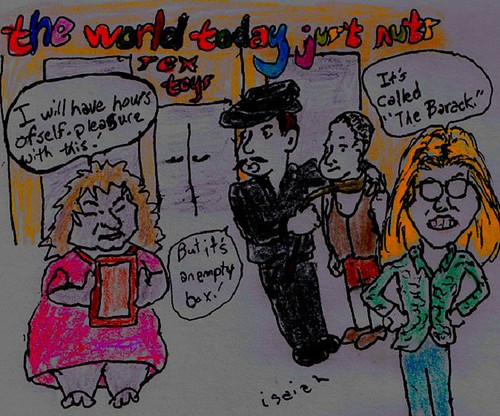
ms troll goes shopping


Like Robin Morgan, our economy still hasn't fixed itself.

On the radio today (NPR), every hour on the hour, was the news that Sony will be laying off at least 10,000 employees. They haven't made their official announcement yet -- that's expected later in the week. And the market drooped as a result of that bad jobs report. As Business Week explains, "The country added 120,000 jobs in March, about half the pace from December through February. Markets were closed Friday, so Monday was investors' first chance to respond."

A consistent at this website since I started it back when Bully Boy Bush occupied the White House is that we need universal, single-payer health care. I have opposed a mandate to purchase insurance because I know how that helped nothing because Mitt Romney was my governor. Yes, before it was ObamaCare, it was RomneyCare. And it didn't help at all.

Chris Hedges' latest column is ObamaCare:

Obamacare will, according to figures compiled by Physicians for a National Health Plan (PNHP), leave at least 23 million people without insurance, a figure that translates into an estimated 23,000 unnecessary deaths a year among people who cannot afford care. Costs will continue to climb. There are no caps on premiums, including for people with “pre-existing conditions.” The elderly can be charged three times the rates provided to the young. Companies with predominantly female workforces can be charged higher gender-based rates. Most of us will soon be paying about 10 percent of our annual incomes to buy commercial health insurance, although this coverage will pay for only about 70 percent of our medical expenses. And those of us who become seriously ill, lose our incomes and cannot pay the skyrocketing premiums are likely to be denied coverage. The dizzying array of loopholes in the law—written in by insurance and pharmaceutical lobbyists—means, in essence, that the healthy will receive insurance while the sick and chronically ill will be priced out of the market.

Medical bills already lead to 62 percent of personal bankruptcies, and nearly 80 percent of those declaring personal bankruptcy because of medical costs had insurance. The U.S. spends twice as much per capita on health care as other industrialized nations, $8,160. Private insurance bureaucracy and paperwork consume 31 percent of every health care dollar. Streamlining payment through a single, nonprofit payer would save more than $400 billion per year, enough, the PNHP estimates, to provide comprehensive, high-quality coverage for all Americans.

But as long as corporations determine policy, as long as they can use their money to determine who gets elected and what legislation gets passed, we remain hostages. It matters little in our corporate state that nearly two-thirds of the public wants single payer and that it is backed by 59 percent of doctors. Public debates on the Obama health care reform, controlled by corporate dollars, ruthlessly silence those who support single payer. The Senate Finance Committee, chaired by Max Baucus, a politician who gets more than 80 percent of his campaign contributions from outside his home state of Montana, locked out of the Affordable Care Act hearing a number of public health care advocates including Dr. Flowers and Dr. Paris; the two physicians and six other activists were arrested and taken away. Baucus had invited 41 people to testify. None backed single payer. Those who testified included contributors who had given a total of more than $3 million to committee members for their political campaigns.


Again, the country does not need ObamaCare.


This is C.I.'s "Iraq snapshot" for Monday:

Monday, April 9, 2012. Chaos and violence continue, Ayad Allawi calls out the direction Iraq's headed in, Iraqis begin to voice displeasure over the White House's indifference to their plight, it's 9 years since the US military pulled down the statue of Saddam Hussein, and more.
Nine years ago today, Gulf News' Mayada al-Askari observes, was "the toppling of Saddam Hussain's statue by the Americans at Al Firdaus Square in Iraq." In 2004, David Zucchino (Los Angeles Times) reported that the April 9, 2003 toppling of the statue was a psyops operation. Before we go further, we should note that the US government is not allowed to use psyop operations on the American people. In fact, that sort of propaganda is why Voice of America is legally prevented from broadcasting in the United States. It's very telling that the Congress refused to investigate what the Los Angeles Times exposed.
Iraqi civilians didn't topple the statue, the US military did: "And it was a quick-thinking Army psychological operations team that made it appear to be a spontaneous Iraqi undertaking."
It was supposed to be the start of democracy in Iraq but there's been no progress. Peter Van Buren, author of We Meant Well: How I Helped Lose the War for the Hearts and Minds of the Iraqi People, and former State Dept employee explains at TomDispatch.com:
Sadly enough, in the almost two years since I left Iraq, little has happened that challenges my belief that we failed in the reconstruction and, through that failure, lost the war.
The Iraq of today is an extension of the Iraq I saw and described. The recent Arab League summit in Baghdad, hailed by some as a watershed event, was little more than a stage-managed wrinkle in that timeline, a lot like all those purple-fingered elections the U.S. sponsored in Iraq throughout the Occupation. If you deploy enough police and soldiers -- for the summit, Baghdad was shut down for a week, the cell phone network turned off, and a "public holiday" proclaimed to keep the streets free of humanity -- you can temporarily tame any place, at least within camera view. More than $500 million was spent, in part planting flowers along the route dignitaries took in and out of the heavily fortified International Zone at the heart of the capital (known in my days as the Green Zone). Somebody in Iraq must have googled "Potemkin Village."
Beyond the temporary showmanship, the Iraq we created via our war is a mean place, unsafe and unstable. Of course, life goes on there (with the usual lack of electricity and potable water), but as the news shows, to an angry symphony of suicide bombers and targeted killings. While the American public may have changed the channel to more exciting shows in Libya, now Syria, or maybe just to "American Idol," the Iraqi people are trapped in amber, replaying the scenes I saw in 2009-2010, living reminders of all the good we failed to do.
This weekend, Heath Druzin (Stars and Stripes) offered, "Iraq experts say that recent developments in Iraq and a growing Iranian influence are signs that America's hopes are dimming for Iraq to become the 'beacon of hope' that President George W. Bush had envisioned in a 2005 speech." Felicity Arbutnot (Global Research) evaluates the 'progress' in Iraq the illegal war has brought: "Also since the invasion, the terrorization, whether for relgious reasons or ransom money, score settling or the unfathomable, in a country were people have co-existed for countless generations, has been bewildering. Overnight (literally) Iraq changed from a land where, broadly, the streets of towns and cities could be walked alone, safely, late at night, to a country which awoke to find while families in morgues bearing wounds indicating unimaginable torture. It woke to beheaded bodies chucked on rubbish dumps -- and beheaded fathers and sons dumped on door steps or in front gardens. Iraq also woke to ransom kidnappings, extortion, destruction of homes, premises, businesses -- or their takeover by force."
In Iraq, the political crisis continues. Liz Sly (Washington Post) observes that "the appearance of calm that has endured for four months has come at a price, many Iraqis say, in the form of Iraqi Prime Minister Nouri al-Maliki's increasingly authoritarian behavior." And she notes, "Sunnis and Kurds, angered by what they see as Maliki's efforts to exclude them from power, accuse the United States of doing little or nothing to restrain his excesses or to press him to implement agreements under which he planned to share power." That latter specifically refers to the Erbil Agreement. So let's provide the recap.

Nouri's State of Law came in second in the March 7, 2010 elections and Iraqiya came in first -- despite the efforts by Nouri to demonize Iraqiya and use the Justice and Accountability Committee to outlaw various Iraqiya candidates weeks prior to the election. Nouri refused to let go of the post of prime minister and, since he had the backing of Barack's White House, he was able to dig in his heels for over months (Political Stalemate I). The gridlock was only ended when all parties signed off on the US-brokered Erbil Agreement. Nouri used the agreement to get a second term as prime minister and trashed the rest of it. That is the beginning of Political Stalemate II (December 2010) which is the country's current crisis. Since last summer, the Kurds have been calling for the Erbil Agreement to be honored. Iraqiya has joined that call as has Moqtada al-Sadr.
Last week, on Thursday, there was supposed to be a meeting, a National Conference. Since December 21st, Iraqi President Jalal Talabani and Speaker of Parliament Osama al-Nujaifi have been calling for the conference to address the political crisis. Less than 24 hours before the scheduled National Conference was to take place, al-Nujaifi announced that it was not taking place.
Liz Sly notes that some Iraqis are seeing US indiference to whatever Nouri might do. She also notes:
Sunni concerns have crystallized in recent weeks around Obama's nomination of Brett McGurk, 38, a lawyer who has frequently advised the U.S. Embassy but is not a diplomat to be the new ambassador to Iraq. As the chief adviser to Ambassador James F. Jeffrey and former ambassador Christopher R. Hill, McGurk is closely associated with the United States' controversial 2010 decision to support Maliki's candidacy as the better hope for future stability over that of Ayad Allawi, the head of the Iraqiya bloc, which narrowly won the most seats in parliament.
We'll get to Allawi in just a moment. But let's deal with Brett McGurk first.
* McGurk is Barack's third nominee for Ambassador to Iraq. Why have all three been men? Iraq -- not just Iraqi women and girls, all of Iraq -- would strongly benefit from the US putting a woman in that post. When Ava and I argued that to members of then President-Elect Barack's transition team we were shot down with the issue of qualfications. No one on the transition team could think of a single woman in the State Dept or out of the State Dept who was qualified -- in their opinion -- to be Ambassador to Iraq. (So don't give me any of that s**t about Barack being a friend to women. He's not. Press whores and idiots repeat that crap. Those of who have dealt with the administration damn well know better.)
* Three nominees and all of the men. McGurk has no qualifications. He's been a coffee fetcher and little else for men who've been in the post. He only graduated colled (as an undergraduate) in 1999. Not only is the lie that they can't find a qualified woman offensive, so is their desire to put a COMPLETELY UNQUALIFIED PERSON in charge of the mission that they plan to spend at least $6 billion dollars on each year through 2016. It is the most expensive State Dept assignment. How in the world do you justify wet-behind-his-ears McGurk as qualified for that position. He's been in no leadership position, he's got little-to-no-experience in oversight or economics and he hasn't even been a mid-level manager. He is completely and totally unqualified.
* Unqualified was Chris Hill. We established that when we reported on his confirmation hearing. He backed it up with his bizarre behavior in Baghdad. (Naps under his desk? Pray those were only rumors, pray.) Because of the Idiot Hill, Barack had to nominate a grown up -- James Jeffrey. Jeffrey's friends are talking all over DC about how Jeffrey does not feel he's gotten the support he needed from the White House that he spends hours trying to explain to the administration that the sky is blue and they keep asking, "Are you sure it's not a little bit green, are you sure?" McGurk may be pliable but he's not qualified. If Jeffrey is not replaced with an adult, Iraq will likely slide towards authoritarianism even faster.
* Barack Obama was not against the Iraq War. That was a stupid little press lie to sell you a War Hawk. To appease voters in Chicago (when he was in the state legislature) he gave a 2002 speech -- a dumb speech. By the time he ran for the US Senate, he wasn't against the Iraq War. (He told Elaine and I that the US was over in Iraq now so it didn't matter. That's not "anti-war.") But the anti-war vote and sentiment took him to the White House. Why the hell has the Cult of St. Barack allowed him to appoint one pro-Iraq War person after another? McGurk is only the latest example of 'anti-war' Barack giving a plum assignment to someone who was pushing the Iraq War in 2002.
Brett McGurk lacks experience, was wrong about the war, is too immature to be put over a $6 billion a year project and Iraqiya -- the political slate that got the most votes -- doesn't want him. If there was a functioning left -- as opposed to the Cult of St. Barack -- McGurk would be announcing right now that he's withdrawing his nomination to spend more time with his family of hamsters.
It has been nine years since U.S. forces removed a brutal tyrant in Iraq at a huge cost in lives and treasure, but already the country is slipping back into the clutches of a dangerous new one-man rule, which inevitably will lead to full dictatorship, and already it is dashing hopes for a prosperous, stable, federal and democratic Iraq. Exploiting the unconditional support of Tehran and the indifference of Washington, Prime Minister Nouri al-Maliki has violated the constitution to consoldiate his own power by using security and military forces to intimidate and oppress political rivals and, indeed, the general population, as manifested in his suppression of peaceful demonstrations in Iraq.
And that's just the opening paragraph. Al Hayat reports that Iraqiya has revealed it is in talks with other blocs about withdrawing confidence in Nouri al-Maliki. The Islamic Supreme Council of Iraq denies that they have engaged in discussions on replacing Nouri. Speaking for the Moqtada al-Sadr bloc, MP Jawad Hasnawi allows that they have serious problems with Nouri but thinks that talk of replacing him is premature. That said, if requested to, Hasnawi says Moqtada would be willing to step in as a prime minister. At the end of this Al Hayat article, KRG President Massoud Barzani offers his concerns that there are serious attempts by the current government in Baghdad to restore Iraq to a dictatorship.
Alsumaria reports that State of Law MP Mohammed Chihod declared today that those seeking a no-confidence vote on Prime Minister and Thug of the Occupation Nouri al-Maliki are "conspirators." He makes other charges; however, that one alone should be seen as disturbing in a country where the likes of Chihod (Nouri's goons) regularly demonize political rivals as "Ba'athists" and "terrorists." It's in that landscape that "conspirators" emerges. A vote of no confidence is not a conspiracy, it's an approved measure with a process outlined in the Constitution.

Chihod shows more ignorance of the Constitution he allegedly took an oath to when he declares the KRG is in violation of the Constitution for refusing to hand Vice President Tareq al-Hashemi over to Baghdad. There is nothing in the Constitution about that. The Constitution does cover immunity for office holders, however. Demonstrating that his ignorance is not limited to the Constitution, Chihod then accuses KRG President Massoud Barzani of visiting the US last week in order to lead on a no-confidence vote in Nouri. A no-confidence vote would take place in the Iraqi Parliament. While it's true that many MPs live outside of Iraq, they're not living in the US.

Meanwhile Al Rafidayn reports on State of Law's whisper campaign against Barzani in which they hurl everything at the wall hoping something will stick. This includes the claim that Barzani's a failure because he wanted the Arab League Summit in Erbil and it was held in Baghdad. Apparently State of Law's inability to govern resulted in a heightened sense of awareness as compensation thereby allowing them to read minds. Barzani's made no comment regarding the Arab League Summit being held in Erbil. It was scheduled for Baghdad and scheduled to be held there in 2011. It was finally held there in 2012. He has called for the national conference (to resolve the political crisis) to be held in Erbil. State of Law brings up the allegations of smuggling oil to Iran and insist these are true and that Barzani is behind the smuggling (the way they go on, we're apparently supposed to picture Massoud Barzani with a hose and gasoline can, stopping beside an oil tanker, ready to siphon the tank). Barzani's trip to the US is called a failure (no reason for that judgment call is given). The whispers also include that Barzani's made a deal with Ahmad Chalabi wherein Ahmad will replace Nouri.
Al Mada reports on an interview Barzani gave in DC after meeting with US Vice President Joe Biden. In it, Barzani noted that Nouri refused a meeting to put all the issues on the table. He cites Nouri as the reason the National Conference failed (it was set for last Thursday but one day prior it was announced the conference was off). He says Iraq is suffering from a real -- not manufactured -- crisis.

Trend News Agency reports that Barzani appeared on Al Arabiya TV and stated Nouri is leading Iraq "to the dicatorship" and that, "If all parties fail to agree on specific changes, then the Kurdish autonomy will no longer regard al-Maliki as Iraqi prime minister". Wladimir van Wilgenburg (Rudaw) adds:

After increased tensions between the Iraqi and the Kurdish governments, Kurdistan Region President Massoud Barzani told Alhurra TV last Thursday that Baghdad is considering the use of F-16 fighter planes against the Kurds.
In the interview, Barzani says the issue with Iraqi Prime Minister Nouri al-Maliki is not personal, but it is about his dictatorial policies. "I still consider him a brother and a friend," he said. According to Barzani, division commanders in the Iraqi army are supposed to be approved by parliament, but this hasn't happened.
Barzani told Alhurra that he has confronted the Iraqi PM many times and been told by Maliki that he will act, but he hasn't, and suggested there is talk of a "military solution" to confront the Kurds in Baghdad. Barzani said that in an official meeting with Iraqi military commanders, it was stated that they should wait for F-16s to arrive to help push back the Kurds.

Aswat al-Iraq notes
, "Shiite Sadrist leader Muqtada al-Sadr said that 'some want to build a dictatorship under the so-called new false reconciliation,' according to the Media Center of his Trend. He did not mention names."
Yesterday, Erbil saw a bombing -- Dar Addustour says it was the first sticky bombing in Erbil -- a sticky bombing is when an explosive device is attached to something, generally with adhesive -- one person was injured in the bombing. In other violence Chen Zhi (Xinhua) reports an armed Tuz_Khurmato attack which left Sahwa leader Sheikh Hussein Awad Khalifa and his bodyguard dead and a Baghdad suicide car bombing claimed the life of 1 bystander and left four more injured.
Yesterday was also Easter. Garibov Konstantin (Voice of Russia) points out, "The US-British invasion destroyed the Christian community in Iraq". The Associated Press notes Pope Benedict XVI's remarks Sunday in St. Peter's Basilica were a call "for peace in Iraq, Syria and elswhere in the Middle East [. . .] Sectarian violence in Iraq, often aimed at Christians, has prompted an exodus over the last years of many from the sizeable Christian community there." Dar Addustour notes Iraqi Christians in Baghdad celebrated Easter under tight security. EuroNews says that "members of the congregation underwent security checks." Rami Ruhayem (BBC News) adds that St. Joseph's Chaldean Church in Baghdad was "surrounded by army checkpoints, and concrete barriers block cars from approaching the entrance." Sanaa Nimr is a pharmacist and she tells Ruhayem, "It's like entering a military camp, not a church." Ruhayem reports, "Alcohol-shop owners and women who did not confirm to Islamic dress codes had suffered intimidation, [MP Yonadem Kanna] added. Mrs Nimr said some Christian schoolchildren had been instructed by teachers to recite verses from the Koran." Nimr explains, "They don't like anyone who is different from them. They cannot tolerate the other -- Muslim or Christian or atheist or whatever." BBC News offers a photo essay of Easter celebrated around the world and the second photo is of a mass at the Armenian Church in Baghdad. Jane Arraf (Christian Science Monitor) reported from Karamiles where, at the St. Addaie the Messenger Church, Christians celebrated Easter:
Like other Christian communities in the disputed areas, a steady stream of families have departed either legally or illegally to Europe and the United States. Despite its own violent upheaval, Syria still serves as a way station for Iraqi refugees hoping for a better life in the West.
The community has been neglected by both the Kurdish and Iraqi governments, says Monsignor Yousif. Water is sometimes cut off for days. There are almost no jobs.
Over the years, some townspeople have made their homes within the crumbling stone walls of the remains of centuries-old homes.
Dar Addustour also notes Kirkuk Governor Najim al-Din Omar Karem maintains Christians in Kirkuk were able to celebrate Easter more publicly and he offered his congratulations to the Cathedral of Kirkuk. Luiza Oleszczuk (Christian Post) reminds, "In Iraq, hundreds of thousands of Christians (even as many as one million, according to some estimates) left the country due to an eruption of sectarian violence that had seen religious minorities targeted, following the 2003 U.S.-led invasion of the country." Ed West (Telegraph of London) calls for England to take in Iraqi Christians and offers this overview:
Christianity in Iraq has a rich past and confusing present. Tradition has it that the faith was brought to Mesopotamia by the Apostles Thomas and Thaddeus, and by the second century the Syriac-speaking people of the region had a thriving church, whose members went on to convert much of Asia. After the Arab conquests, Syriac Christians played a pivotal role in Islamic civilisation's high point; of 60 scholars who preserved the works of the ancients by translating them into Arabic, 58 were Christian (of the other two, one was Jewish and the other a Sabaean).
Today there are six Christian denominations (not including tiny numbers of Protestants), the largest of which is the Chaldean Catholic Church, which came into communion with Rome in the 16th century, followed in size by two Assyrian Orthodox churches. Assyrians speak neo-Aramaic (a modern form of Syriac) and identify as a distinct Semitic ethnic group; and although the term Chaldo-Assyrian is often used to emphasise the unity of Iraqi Christians, some Chaldeans identify simply as Christian Arabs. Others, especially those who hail from southern Turkey, call themselves Syriacs or Arameans and doubt the validity of the term "Assyrian", which only dates as a modern ethnic term to the 19th century, but nonetheless consider themselves to be one people.
Last month, the United States Commission on International Religious Freedom released [PDF format warning] their 2012 Annual Report of the "worst religious freedom violators" which includes Iraq on the list. The Commission found:
The Iraqi government continues to tolerate systematic, ongoing, and egregious religious freedom violations. In the past year, religious sites and worshippers were targeted in violent attacks, often with impunity, and businesses viewed as "un-Islamic" were vandalized. The most deadly such attacks during this period were against Shi'a pilgrims. While the Iraqi government has made welcome efforts to increase security, it continues to fall short in investigating attacks and bringing perpetrators to justice. It also took actions against political rivals in late 2011 that escalated Sunni-Shi'a sectarian tensions. Large percentages of the country's smallest religious minorities -- which include Chaldo-Assyrian and other Christians, Sabean Mandaeans, and Yazidis -- have fled the country in recent years, threatening these ancient communities' very existence in Iraq; the diminished numbers that remain face official discrimination, marginalization, and neglect, particularly in areas of northern Iraq over which the Iraqi government and the Kurdistan Regional Government (KRG) dispute control. Religious freedom abuses of women and individuals who do not conform to strict interpretations of religious norms also remain a concern.
Based on these concerns, USCIRF again recommends in 2012 that Iraq be designated as a "country of particular concern," or CPC. USCIRF has recommended CPC status for Iraq since 2008, and placed Iraq on its Watch List in 2007.
Although the Iraqi government has increased security and reportedly prevented several bombings, Muslim and Christian religious sites and worshippers still experienced violent attacks in 2011 - 2012. Four individuals were convicted and sentenced for the high-profile October 2010 attack on a Catholic church in Baghdad, but there appeared to be little progress in investigating and prosecuting perpetrators of other attacks. Sunni -Shi'a sectarian tensions increased significantly in late 2011 after the Shi'a-led government sought to arrest or fire senior Sunni officials. Christian and Yazidi businesses deemed "un-Islamic," such as liquor stores, were vandalized in Baghdad and the KRG region during 2011. Non-Muslims and ethnic minorities in disputed areas continued to report abuses against women, girls, and secular Iraqis. Violence against Iraqi civilians continued in 2011 at approximately the same level as in 2010. Large numbers of Iraqis, many of whom fled religious persecution, remain displaced internally or outside the country, including in Syria where the security situation is increasingly dire.
Since the start of the illegal war, Iraq has had an ongoing exodus. The professional class was the first to leave ("the brain drain"). As each year of the war and occupation started up, more and more Iraqis were leaving. By 2008, Iraq was the largest refugee crisis in the Middle East since 1948. Most do not get passage to Europe or the US and instead head for a neighboring country such as Jordan and Lebanon (and Syria until recently).From there some have received aslyum in other countries and others have entered Europe through a non-official process.
The UNHCR estimates that Iraq currently has 1,343,568 internally displaced people and 1,683,579 external refugees. In addition, Iraq has an estimated 34,655 refugees in its country. That includes the 3,400 residents of Camp Ashraf as well as Palestinians. They aren't the only ones. Benjamin Hiller (Berlin: Between Photo & Journalism) notes:
During my recent stay in Iraq I visited a refugee camp for Iranian Kurds about an hour by car from Hawler (Erbil) while the Kurdish New Years festivity Newroz was being celebrated. Established 18 years ago roughly 400 people live in this camp of small concrete buildings, dust and surrounding fences. The people had to flee Iran due to alleged ties to groups opposing the central government in Tehran.
The camp was constructed with some help by the KRG (Kurdish Regional Government) and external donors, but the main work was done by the refugees themselves. Currently the children living in the camp, most of whom were born there, can attend a nearby school. But the situation is still dire -- as the adults are only allowed to work one week a year. A small store the refugees had set up on a street just outside of the camp to sell merchandise to passersby was closed down by the KRG as they had no official license. Their only regular income is a support payment by the Iranian-Kurdish Party: 20,000 Iraq Dinar a month -- around 17 Dollars.
Over the weekend, Iraq's oil was in the news -- specifically in terms of the disputes between the Baghdad-based central-government and the Kurdistan Regional Government. All last week, Baghdad insisted that ExxonMobil had cancelled its contract with the Kurds. As Reuters noted, the Kurds have stated the deal made in October is still on. Aabha Rathee (Wall St. Cheat Sheet) reported, "A statement on the Kurdish president Masoud Barzani's website said Exxon chief executive officer Rex Tillerson has reaffirmed the company's commitment. "Rex Tillerson renewed the commitment of his company's signed contracts with Kurdistan and Iraq and expressed the readiness of Exxon Mobil to continue its work in Kurdistan," the statement said." The Kurdish Globe also noted the story. The Trefis Team (Forbes) offers this background:

Exploration companies have been lured to sign contracts with the KRG as it has offered attractive production sharing contracts while the central government has given out service contracts that compensate players based on a production linked fee. [1] The better security environment in Kurdistan also makes the region more lucrative to companies intending to set up local operations. However, despite these advantages, most oil majors have stayed clear of pursuing deals with the KRG to avoid antagonizing the central government, which does not recognize the validity of such regional contracts.


ExxonMobil is not the only issue of difference between the Nouri's government and the Kurdistan Regional Government. Pierre Betran (International Business Times) noted KRG President Massoud Barzani's visit to DC this week and points out, "At the heart of the Kurdish-Arab dispute is a constitutional provision that Kurdish President Massoud Barzani said last week hasn't been implemented by Baghdad. Speaking in Washington, he said the provision is designed to set governing and power-sharing agreements between the two governments. The law would also repatriate strategic oil-rich parts of Iraq to Kurdistan."
And back to the US for this from Emma Cape's "Mark the second anniversary of Collateral Murder: help us free Bradley Manning" (Bradley Manning Org):

On April 5, 2010, WikiLeaks released the Collateral Murder video, depicting the killing of civilians and Reuters journalists, and the severe wounding of two children by a U.S. apache helicopter in Iraq. The Reuters news organization had unsuccessfully filed a Freedom of Information Request after the incident to obtain the video. However, it was the WikiLeaks whistle-blower, allegedly PFC Bradley Manning, who took action to expose the horror that took place that day.

Since then, WikiLeaks has become well known worldwide, and Bradley Manning has been nominated twice for the Nobel Peace Prize.

To honor the second anniversary of the video's release, we ask that you gather your friends and neighbors sometime during the week of April 15-21 to show them the video and start a discussion about why Bradley Manning deserves to be freed.

Below are links to a downloadable version of Collateral Murder and an interview with soldier Ethan McCord, seen rescuing children out of the van in the video. You can share the videos with your guests to start the discussion about advocating for Bradley.

Download Collateral Murder here.

Suggested questions:
  • How are you feeling after watching this video?
  • Have you seen the video in the news or have you heard friends talk about it? How do you think the release of the video has impacted your community?
  • In his supposed Instant Messaging conversation with Adrian Lamo, the hacker who reported Bradley to the authorities, Bradley states the information should be in the public domain because "without information, you cannot make informed decisions as a public." Do you agree?
Bradley Manning was arrested one month after this video was made public.

alsumaria
trend news agency
rudaw
wladimir van wilgenburg
aswat al-iraq
the voice of russia
garibov konstantin
al mada
al rafidayn
dar addustour

Friday, April 06, 2012

Spaghetti Squash in the Kitchen

Becky wants to share this recipe from Spark people:


LinkA great alternative to famous comfort food - spaghetti!
Number of Servings: 4

Ingredients

    1 Medium Spaghetti Squash
    1 Can of Tomatoes, chopped
    Italian Seasoning
    1/4 Cup of Parmesan Cheese, grated
    Salt and Pepper to taste.


Directions

Preheat the oven to 350 degrees.

+ Cut the squash in half, and scoop out the seeds.
+ Place both halves of the squash in a shallow baking dish with a little water.
+ Bake for 45-60 minutes or until tender.
+ Mix tomatoes and italian seasoning to create a marinara sauce.
+ Let squash sit until cool/warm. (Not hot!)
+ Carefully take a fork and begin scraping the inside of the squash creating a "spaghetti-like" resemblance.
+ Spoon spaghetti squash onto a plate and top with marinara sauce.
+ Serve with parmesan cheese.


* I add black olives sometimes for a little extra kick! This recipe can be interchanged with any pasta dish. I also like this with shrimp and a olive-oil garlic sauce. It's a great recipe!

Number of Servings: 4

As Becky points out, this is an easy recipe and one that's very healthy too. Spark People is a resource I wasn't aware of until Becky e-mailed. There are many great recipes at the site so please check it out.


Meanwhile the jobs report. It's a joke. The economy isn't getting better and here's Larry Johnson (No Quarter):

No good news in the unemployment numbers released this morning. Only 120,000 new jobs. That does not even keep pace with population growth. In case you forgot, 144,000 new job seekers enter the market every month. That means we have generate at least 140,000 new jobs just to keep pace with population growth.

So job growth sucks, but the Bureau of Labor Statistics is playing major games and reporting the misleading claim that unemployment dropped by .1%. A close look at the actual numbers shows we are not moving in the right direction. (Click here for the numbers.)

Is the Bureau spinning? I'm not sure. The numbers themselves, however, don't lie and it's is not good. There are still not enough jobs being created to even make a dent and I'm guessing we'll see that in a few more months. Specifically in the first month of graduations. June will be a telling month.

But the numbers themselves aren't lies. The spin around them is.

This is C.I.'s "Iraq snapshot" for Friday:

Friday, April 6, 2012. Chaos and violence continue, Home Depot gets sued by the US Justice Dept over the firing of a National Guard member, KRG President Massoud Barzani visits the US and discusses Article 140 (and more), now Nouri doesn't want Tareq al-Hashemi to return to Iraq, Ammar al-Hakim calls out Nouri's raid on the Communist Party last week, and more.
Iraqi Vice President Tareq al-Hashemi is currently on a diplomatic tour of the surrounding region having already visited Qatar and currently Saudia Arabia. Raman Brosk (AKnews) reports that State of Law is arguing that al-Hashemi should not be allowed to re-enter Iraq and Iraqiya's spokesperson Maisoun al-Damlouji is responding, "This is not acceptable at all. Hashemi is the vice president of the Republic and he will return to the region." In December, after most US troops left, Nouri al-Maliki upped the political crisis by insisting that Deputy Prime Minister Saleh al-Mutlaq be stripped of his post and that Vice President Tareq al-Hashemi be arrested on charges of 'terrorism.' Both al-Mutlaq and al-Hashemi are members of Iraqiya (both are also Sunni) which is the political slate that won the most votes in the March 7, 2010 elections. Nouri's State of Law slate came in second to Iraqiya. The two slates are political rivals. As an Iraqi correspondent for McClatchy Newspapers observed at Inside Iraq this week:
In a press conference Maliki said that he had a criminal file on Hashimi that he had been sitting on for three years, and was now ready to prosecute him. For the objective observer, the timing of this announcement was telling. [. . .] Confessions of Hashimi's security personnel were aired on state television and an arrest warrent for Hashim himself was issued and also made public on state TV -- All this publicity on Maliki's side in order to burn the bridges and make any political deal impossible in this country where government is glued together with political deals.
A day after al-Hashemi went to the KRG, Nouri issued the arrest warrant. Tareq al-Hashemi has remained in the KRG as a guest of Iraqi President Jalal Talabani and KRG President Massoud Barzani. Sunday he left for a diplomatic tour of some of the neighboring Iraq countries. He has visited Qatar and Saudi Arabia.
Providing background on Nouri's relationships with Qatar and Saudi Arabia would require many, many snapshots. So we'll just drop back to last week's Arab League Summit held in Baghdad. Abeer Mohammed and Khalid Walid (Journal of Turkish Weekly) report:

While Iraq hoped the high-profile Arab League summit in Baghdad last week would mark a step forward in relations with its neighbours, observers say many regional states used the event to snub the government.
Although officials declared the event a success, only ten leaders from the 22 Arab League member states turned up. Apart from Kuwait, no Gulf state was represented at a high level. Saudi Arabia and Oman merely sent their Cairo-based Arab League ambassadors.


As demonstrated by actions this week (see Liz Sly's Washington Post report from yesterday) the Arab League Summit changed nothing of importance for Iraq. This despite all the money spent on it. And several countries were able to use the summit to send a message. That message was received loud and clear by Nouri who responded by attacking Qatar and Saudi Arabia over the weekend -- before al-Hashemi arrived there. And the attacks continue. Today Alsumaria reports that Nouri's State of Law again elevated the rhetoric against Saudi Arabia and Qatar today as Abbas al-Bayati declared that the press for both countries was carrying out their governments' attack on Iraq's government.
AFP reports that a spokesperson for Tareq al-Hashemi declared today -- as al-Hashemi has all week -- that he will return to Iraq after he's concluded his diplomatic mission and "that for Hasemi to remain abroad was 'the wish of his enemies,' in a clear reference to Maliki." There is something very comical about Nouri's attitude as the week ends.
It started with him and his spokespeople blustering and bellowing about how Qatar would hand al-Hashemi over to Baghdad (they didn't) and how INTERPOL would show up if needed to remove al-Hashemi from Qatar and bring him to Baghdad. That was never going to happen as we explained on Sunday and Monday -- it is written into INTERPOL's charter that it does not take part in political arrests and that is so that INTERPOL will be seen as impartial. So he demanded Qatar hand the vice president over and then demanded the same of Saudi Arabia, insisted INTERPOL would return him and now Nouri's position is that Tareq al-Hashemi should not be allowed to re-enter the country?
In addition to the laughs prompted by Nouri's flip-flops, grasp that Nouri's court is supposed to try al-Hashemi May 3rd. And Nouri's position is that al-Hashemi can't come back into Iraq?
In Iraq, the political crisis continues and intensifies.
The March 7, 2010 elections were followed by over 8 months of gridlock known as Political Stalemate I. Nouri al-Maliki did not want to abide by the Constitution or the will of the Iraqi people expressed at the ballot box. He did not want to stop being prime minister. In 2014 (or 2015 the way Nouri drags his feet), this may be an issue again because although when Iraqis took to the streets in large number protesting against corruption in his government and more (February 25, 2011), he swore he would not run for a third term, his spokespeople and attorney have repeatedly told the press that Nouri is not bound by that and may decide to run again.
With the White House backing him for a second term, Nouri knew he didn't have to compromise and could just stomp his feet in the hopes of getting his way.
In an attempt to soothe the stubborn child, the political blocs agreed to end the stalemate by signing off on the US-brokered Erbil Agreement. That was November 2010. By the end of December 2010, it was obvious that the only thing Nouri really intended to honor from that agreement was that he would get a second term as prime minister. For months, the other political blocs waited and waited for the agreement to be implemented. It never way. Over the summer last year, the Kurds made it clear that the country needed to return to the Erbil Agreement. Iraqiya quickly joined that call, then Moqtada al-Sadr and then others.
Many Iraqis -- Sunnis, Shiites and Kurds alike -- fear that the U.S. withdrawal has given Prime Minister Nouri al Maliki, a conservative Shiite Islamist, free rein to consolidate power and turn himself into an intractable strongman.
Those worries were only compounded when the White House last month named Brett McGurk the new U.S. ambassador to Baghdad. As adviser to the past three envoys, McGurk had garnered a reputation among Iraqi political elites as a die-hard Maliki booster who turns a blind eye to the prime minister's emerging dictatorial streak.
"They basically sent someone from Maliki's office," one Sunni politician grumbled privately about the Obama administration's choice.
In December of last year, when Nouri went publicly nuts (deploying tanks to circle the homes of political rivals, for example), Speaker of Parliament Osama al-Nujaifi and Iraqi President Jalal Talabani began calling (December 21st) for a national conference to address the crisis. That was supposed to have taken place yesterday; however, it was called off at the last minute. Al Mada notes that Iraqi President Jalal Talabani is calling for a new date to be set for a national conference to resolve the ongoing crisis in Iraq and that State of Law, as evidenced by the statemetns of Hussein Shahristani, is pleased that the conference was cancelled.
In what Nouri hopes is an isolated move, Al Mada reports State of Law MP Jawad Albzona has withdrawn from Nouri's coalition and stated that he would prefer to be independent which, he believes, will allow him to better represent Iraqis by distancing himself from political squabbles and moving towards the needs of the citizens of Iraq. He is the second State of Law MP to announce a departure since 2010. Since December, he has repeatedly made public statements decrying the current political crisis and asking for the politicians to work on issues directly effecting the lives of Iraqis. An issue effecting Iraq's internally displaced refugees is living among piles of garbage Al Rafidayn reports. Currently the United Nations estimates there are 1.3 million displaced Iraqis within Iraq. On Albzona's departure from State of Law, Al Rafidayn notes the MP declared he will remain a member of the National Alliance (a larger coalition of Shi'ite political blocs).
Meanwhile the leader of the Islamic Supreme Council of Iraq (also a member of the National Alliance), Ammar al-Haskim, has weighed in on two key issues. Al Mada reports he declared the poverty program of the last two years a failure, noting that it has not reduced the rate of poverty in Iraq. He is calling not only for a new program and strategy but for the budget to reflect a strong goal to reduce poverty. In regard to the raid Nouri ordered last week on the Communist Party's newspaper headquarters, al-Hakim stated that when security forces violate the rights of the people negative images are reinforced and that the role of the security forces is to protect freedoms (not attack them). He decried the arrest of 12 people in the raid on the Communist Party. Last week, Iraqiya leader Ayad Allawi condemned the raid. From the March 28th snapshot:

We'll close by noting the disturbing news of the day and news that wasn't picked up and front paged but should have been. Nouri al-Maliki is now going after Iraq's Communist Party. Al Mada reports that Nouri's security forces stormed the political party's headquarters and arrested 12 people who were arrested and questioned about protests. Ali Hussein (Al Mada) notes the Communist Party has a long history of fighting for Iraq, not against it. Hussein reports that Nouri's tanks have been sent to surround the homes of Communist Party members in Baghdad. Those who paid attention in December will remember that Nouri ordered tanks to circle the homes of Iraqiya members right before he demanded that Deputy Prime Minister Saleh al-Mutlaq be stripped of his posts and ordered the arrest of Vice President Tareq al-Hashemi on charges of terrorism. Both al-Mutlaq and al-Hashemi are members of Iraqiya as well as Sunnis. Ali Hussein notes that Nouri also ordered tanks to circle the homes of Communist Party members last year.


The Iraq Communist Party Tweeted last week, "Iraqi Communist Party condemns raid of its newspaper headquarters by security forces." They state that the raid took place late in the evening Monday and that their headquarters were ransacked by federal police who entered claiming that they were doing a sweep of the area for the Arab League Summit. An old weapon ("piece of junk") was on the roof and they used this as a pretext to arrest 12 of the people who were held overnight and only released after they signed documents -- documents they were forced to sign while blindfolded. While they were held, the federal police returned to the now empty headquarters and ransacked the place.
Add a third political leader to the list. In DC yesterday, Kurdistan Regional Government President Massoud Barzani was asked if Nouri's authoritarian ways were reason to be concerned as he consolidated complete control of the security forces and Barzani responded, "The new Iraqi army needs to be built on the basis of being the army of the country, not an army of an individual. So to be an army that belongs to the people of Iraq and the state of Iraq in accordance with the Constitution and the laws. And also the Iraqi army should not interfere in the internal political differences of the country. "
ABC News notes, "Barzani, who was in Washington to meet with President Obama and Vice President Joe Biden, said that unless Baghdad resolves simmering disputes involving its ethnic and political factions, the situation would be ripe for an autocratic government." Hurriyet Daily News adds, "The Obama administration has pressed Kurdish Regional Government (KRG) leader Masoud Barzani to re-engage with Baghdad amid high tension over the status of fugitive Iraqi Vice President Tariq al-Hashemi. Al-Hashemi arrived in Saudi Arabia on April 4 and accused his country's prime minister of waging a systematic campaign against Sunni Arabs in Iraq." Today's Zaman reports:
"Barzani visited the US to complain about Maliki," said one diplomat on Friday, speaking on condition of anonymity. Barzani met with President Barack Obama and with Vice President Joe Biden separately on Wednesday, and told them that Maliki is consolidating power in a dictatorial way. He said Obama and Biden reassured him that the United States would remain committed to cooperation with Kurdistan and committed to helping Iraq solve its serious internal political problems.
[. . .]
Bilgay Duman, an expert on Iraq from the Ankara-based Center for Middle Eastern Strategic Research (ORSAM), stated that Barzani's reception by high-ranking US officials should be perceived as a warning to Maliki to abandon his sectarian-based policies in the country. Iraq is suffering from severe instabilities due to daily clashes between Shiite and Sunni groups, which escalated after US troops withdrew from the country in December. The KRG is striving to maintain balanced ties with Iraq's rival Sunni and Shiite groups as they vie for influence in the country following the US withdrawal. Turkey is very critical of Maliki, saying the Shiite prime minister is using the arrest warrant against Hashemi to sideline Sunni political groups in the administration and hoard power for dominance of the Shiite bloc.
"The stance of Arbil and Ankara against Baghdad are very much in line, due to the fact that both are disturbed by Maliki's dictatorial government," affirmed Ali Semin, a Middle East expert from the Turkish think-tank -- the Wise Men Center for Strategic Studies (BİLGESAM). He added that the US is now trying to forge ties between KRG and Turkey in order to secure the unity of Iraq.
So that we're all on the same page, the 2005 Iraqi Constitution includes Article 140:
First: The executive authority shall undertake the necessary steps to complete the implementation of the requirements of all subparagraphs of Article 58 of the Transitional Administrative Law.
Second: The responsibility placed upon the executive branch of Iraqi Transitional Government stipulated in Article 58 of the Transitional Administrative Law shall extend and continue to the executive authority elected in accordance with this Constitution, provided that it accomplishes completely (normalization and census and concludes with a referendum in Kirkuk and other disputed territories to determine the will of their citizens), by a date not to exceed the 31st of December 2007.
The census and referendum are to take place no later than December 31, 2007. Nouri al-Maliki becomes prime minister in 2006. He took an oath to the Iraqi Constitution. He never ordered the census or the referendum before the end of 2007. His first term ended with him unable/unwilling to abide by the Constitution he took an oath to uphold. There has been no census or referendum. He is and remains in violation of the Constitution.
With that understanding, we'll now note what KRG President Massoud Barzani declared yesterday in DC at the forum put on by the Washington Institute for Near East Policy on the issue of Kirkuk and Article 140.
President Massoud Barzani: Article 140 is a Constitutional Article and it needed a lot of discussions and talks until we have reached this. This is the best way to solve this problem. It's regarding solving the problems of the territories that have been detached from Kurdistan Region. In fact, I do not want to call it "disputed areas" because we do not have any disputes on that. For us it is very clear for that. But we have shown upmost flexibility in order to find the legal and the Constitutional solution for this problem. And in order to pave the way for the return of these areas, according to the Constitution and the basis of law and legally to the Kurdistan Region. And we have found out that there is an effort to evade and run away from this responsibility for the last six years in implementing this Constitutional Article. And I want to assure you that implementing this Constitutional Article is in the interest of Iraq and in the interest of stability. There are people who think that time would make us forget about this. They are wrong. Time would not help forget or solve the problem. These are Kurdish countries, part of Kurdistan and it has to return to Kurdistan based on the mechanism that has been stipulated in the Constitution. And at the end of the day, as the Constitution stipulates, it's going back to what the people want to determine. So there is a referendum for the people of these areas and they will decide. If the people decide to joing Kurdistan Region, they're welcome and if the people decide not to, at that time, we will look at any responsibility on our shoulders so people would be held responsible for their own decisions.
Barzani is not calling for any additional steps to resolving the issue of Kirkuk, he is only asking that what was already agreed to and written into the Constitution be followed. In addition to taking questions, Barzani delivered a speech at the forum and you can see yesterday's snapshot for that.
President Massoud Barzani: As far as the second part of your question, the Erbil Agreement. In fact, the agreement was not only for the sake of forming the government and forming the three presidencies -- the presidency, the Speakership of Parliament and premier. In fact, it was a package -- a package that included a number of essential items. First, to put in place a general partnership in the country. Second, commitment to the Constitution and its implementation, the issue of fedarlism, the return of balance of power and especially in all the state institutions,the establishment in [. . .] mainly in the armed forces and the security forces, the hydrocarbons law, the Article 140 of the Constitution, the status of the pesh merga. These were all part of the package that had been there. Had this Erbil Agreement been implemented, we would not have faced the situation that we are in today. Therefore, if we do not implement the Erbil Agreement then there would certainly be problems in Iraq.
Again, the political crisis did not start over the accusations Nouri hurled at Saleq al-Mutlaq and Tareq al-Hashemi. The failure to follow the Erbil Agreement -- the document ending Political Stalemate I -- is what caused the current crisis -- a crisis that has now lasted over a year and four months.
Turning to the United States, yesterday Caitlin Duffy (Forbes) reported of Home Depot, "The home improvement retailer's shares are once again hitting fresh multi-year highs, with the stock up 1.4% on the day at $50.56 as of 12:35 p.m. in New York trade. Call activity on Home Depot suggests at least one strategist is gearing up for the bullish momentum to continue in the near term." But how long will the outlook remain bullish as word leaks out about a new lawsuit? The US Justice Dept issued the following yesterday:


WASHINGTON -- The Justice Department announced today the filing of a complaint in U.S. District Court in Arizona against Home Depot U.S.A. Inc. for violating the employment rights of California Army National Guard soldier Brian Bailey under the Uniformed Services Employment and Reemployment Rights Act of 1994 (USERRA).


The department's complaint alleges that Home Depot willfully violated USERRA by terminating Bailey's employment because of his military service obligations. Bailey, an Iraq War veteran, worked at a Home Depot store in Flagstaff, Ariz., as a department supervisor while at the same time serving in the California Army National Guard. Throughout his employment with Home Depot, Bailey took periodic leave from work to fulfill his military obligations with the National Guard. According to the Justice Department's complaint, Bailey was removed from his position as a department supervisor after Home Depot management officials at the Flagstaff store openly expressed their displeasure with his periodic absences from work due to his military obligations and further indicated their desire to remove him from his position because of those absences.


Bailey initially filed a complaint with the Labor Department's Veterans' Employment and Training Service, which investigated the matter, determined that the complaint had merit and referred the matter to the Justice Department. The Justice Department's Civil Rights Division subsequently decided to represent Bailey in this matter and filed this lawsuit on his behalf.


USERRA prohibits employers from discriminating against National Guard soldiers, such as Bailey, with respect to employment opportunities based on their past, current or future uniformed service obligations. Under USERRA, it is unlawful for an employer to terminate an employee because he has to miss work due to military obligations.


Among other things, the suit seeks compensation for Bailey's lost wages and benefits, liquidated damages and reinstatement of Bailey's employment with Home Depot.


"The men and women who wear our nation's uniform need to know that they do not have to sacrifice their job at home in order to serve our country," said Thomas E. Perez, Assistant Attorney General for the Civil Rights Division. "The Civil Rights Division is committed to aggressive enforcement of USERRA to protect the rights of those who, through their bravery and sacrifice, secure the rights of all Americans."


"The National Guard is composed primarily of civilian men and women who serve their country, state and community on a part-time basis," said Acting U.S. Attorney Ann Birmingham Scheel. "National Guard members, and their employers, should know that we will employ all of USERRA's tools to protect the employment rights of those in uniform while they sacrifice time away from their families and jobs for training and active duty."


This case is being handled by the Employment Litigation Section of the Justice Department's Civil Rights Division and the U.S. Attorney's Office for the District of Arizona.


Additional information about USERRA can be found on the Justice Department websites www.usdoj.gov/crt/emp and www.servicemembers.gov, as well as the Labor Department website www.dol.gov/vets/programs/userra/main.htm.
12-434
Civil Rights Division
Staying with the issue of the US military, on Saturday, David Brown (Washington Post) reported on studies -- apparent Pentagon studies -- that researched the signature wounds of the modern wars and demonstrated a weak link between TBI (Traumatic Brain Injury) and PTSD (Post-Trumatic Stress Disorder) and "outright violent behavior." As we have noted for years here, those suffering from PTSD are far more likely to self-harm than to harm others. That was true not only in the early research on PTSD during these wars but true as well when you go back to studies on similar conditions such as what was once known as "shell shocked." In all of that, self-harm could and sometimes did include self-medicating with alcohol or other drugs. What's distrubing about the Post report is "outright violent behavior." Some might agree (some might not) with the conclusion that a drunken brawl with a friend isn't "outright violent behavior." I would hope at this late date, in the US, no one would conclude -- as the Pentagon apparently has -- that domestic abuse is not "outright violent behavior." Domestic abuse is a crime. it is a serious crime. The military can do whatever they want with drunken brawls among friends, I don't really care (some people may), but when you classify domestic abuse as something other than "outright violent behavior," we do have a problem -- a very serious problem. Domestic violence is a crime, it is violence and I think a strong argument can be made that it's a form of terrorism. As Maureen Orth detailed in Vanity Fair nearly nine years ago, there are life and death consequences. The US military has a long history of looking the other way when a woman is assaulted or raped. Supposedly that's changed. We heard it over and over, for example, from then-Secretary of Defense Robert Gates when he would appear before the Congress. But if the climate actually had changed, beating a woman would not be classified as something less than "outright violent behavior."
In related news on this still-existing culture of denial within the higher ranks of the US military, Sandra S. Park (ACLU Blog of Rights) noted the following disturbing event on Monday:
While it is estimated that over 19,000 sexual assaults occurred in the military in 2010, a rate far higher than among civilians, the government has failed systematically to investigate complaints, appropriately punish perpetrators, and treat trauma and other health conditions suffered by survivors. The profound personal and social consequences that arise from the government's systemic failures are powerfully profiled in the new film, The Invisible War. Turning a blind eye to these crimes has allowed them to continue, imperiling the lives of victims and degrading their service.
On Friday, a federal district court judge cited yet another example of the military's unwillingness to acknowledge sexual violence within its ranks. In response to Freedom of Information Act requests filed by the Service Women's Action Network (SWAN) and the ACLU seeking records from the Departments of Defense and Veterans Affairs regarding their response to sexual assault, sexual harassment, and domestic violence in the military, the Army Crime Records Center claimed it couldn't provide records about "sexual assault" because its records are organized by specific criminal offenses such as "rape," not under the general heading of "sexual assault."
"'Sexual assault' is easily read as encompassing rape and other non-consensual sexual crimes defined in the Army's offense codes," the judge found. "The fact that the agency was unwilling to read the Plaintiffs' request liberally to include such terms seems to be almost willful blindness."
The judge further ruled that several other sections of the Departments failed to adequately respond to our requests and ordered the government to fulfill its obligations under FOIA. We will continue to press the government for the information we need to truly understand, address, and end the epidemic of sexual violence in the military.

Thursday, April 05, 2012

Sad

Fred Mazelis (WSWS) reports:

While the Obama administration trumpets the allegedly good news that the official US jobless rate has fallen to 8.3 percent, millions of unemployed workers are facing new attacks on their unemployment benefits, in the form of tightened eligibility standards and cuts in the duration of benefits.
In the past year, 11 out of the 50 states have implemented cutbacks in the form of eligibility or duration. Last week Georgia became the latest in this list, when its legislature adopted a bill that reduced state benefits from 26 weeks to a sliding scale of between 14 and 20 weeks, depending on the state unemployment rate.


Can you imagine that? No job. Benefits cut off.

What do you do?

A friend of mine is ticked off at Yahoo Mail. She lost her account and had to start all over, re-registering as a new user. (How did she lose her account? Identity theft.)

So she goes to register and they require you pick two security questions and answer them.

The first one wanted to know a favorite relative -- uncle, etc. -- or a question about your spouse.

She's not married.

And she was raised in an orphanage and never knew any family.

What the hell was Yahoo thinking?

But I read the WSWS article and I think about someone like her. What if she had lost her job and she was about to run out on benefits?

She could move in with us, she's a good friend. But she might not want to and if we disappeared, she might not have us as a fallback.
This is C.I.'s "Iraq snapshot" for Thursday:

Thursday, April 5, 2012. Chaos and violence continue, the national conference does not take place, KRG President Massoud Barzani makes clear that the Kurds will not be put off any more, al-Hashemi continues his diplomatic tour, UN Secretary-General Ban Ki-moon calls for Iraq to halt executions, and more.
Oil, if Iraq didn't have it, the illegal war might never have started in 2003. Oil continues to be a source of violence and conflict within Iraq. For example, an apparent bombing has stopped a pipeline. Ali Berat Meric and Emre Peker (Bloomberg News) report that the Kirkuk-Yumurtalik pipeline is not transporting oil to Turkey currently after a bombing took place within Turkey damaging the pipeline. Orhan Coskun (Reuters) reports, "There were three almost simultaneous explosions at separate points along the pipeline in the Idil area, a Turkish security official said."
There's violence and the conflict? At this point, that's primarily between the central-government in Baghdad and the Kurdistan Regional Government. Nouri took the ongoing disagreement to a new level this week when his government accused the Kurds of selling blackmarket oil to the government of Iran. Alsumaria TV reported the Kurdistan Alliance denied the charges and accused Deputy Prime Minister of Energy Hussein al-Shahristani of declaring war on them and they are calling for him to apologize to the Kurdish people for his accusations. As RT noted, the Kurds were already unhappy with Baghdad over a $1.5 billion debt that they say the centeral-government owes them and that the refusal to pay led the KRG to halt their Baghdad oil deliveries at the start of the week after ten consecutive months of no payment from Baghdad. Alsumaria quotes KRG Natrual Resources Minister Ashti Hawrami telling the press, "Kurdistan Government will not resume oil export before it reaches a comprehensive agreement with Baghdad about payment methods and dues to oil companies in the Region. Kurdistan Government will only resume oil export when it reaches a general agreement with Baghdad." The editorial board of The National offered:
This is, above all else, a political disagreement. And it's a disagreement that is harming both sides. Kurdish leaders are asserting their autonomy that, in terms of state institutions and security forces, is already a fact on the ground. A charitable view is that Mr Al Maliki is trying to unify a national energy sector; an alternative explanation is that Baghdad is trying to monopolise national resources for the exclusive benefit of his constituency.
The casualty in this case is the national economic project. After more than three years of haggling, Iraq's oil law seems no closer to being passed, which in turn harms foreign investment in the sector. Baghdad objects to the deals the KRG has struck independently with oil majors; on Monday, Exxon Mobil confirmed that it had frozen an exploration contract in the Kurdish region because of pressure from Baghdad.
ExxonMobil may or may not have confirmed that. Reuters notes today, "The central government now says that Exxon has written to it twice since early March to say that its deals with the Kurds have been suspended. The Kurds say Exxon has not halted work in Kurdistan and have challenged Baghdad to publish Exxon's letters." And the battle over ExxonMobil is being watched as the Reuters points out:
Oil majors are now waiting on the sidelines, watching the outcome of Exxon's balancing act between Baghdad and Arbil, the northern capital. France's Total is the latest company to provoke Baghdad's ire by acknowledging interest in Kurdistan. "What companies are trying to do is get to the point where they are investing in the north and the south," said one industry source working in Iraq. "But at the moment they cannot do that. And that is what you have to build in when you decide whether to move in or not. You balance the risks."
So the status of the ExxonMobil deal with the KRG is not known at this point. What is known?
Relations between Erbil and Baghdad were strained even before the controversy over the Exxon Mobil deal flared anew. Kurdish President Massoud Barzani delivered a stinging speech on Thursday in Washington that ripped into Maliki as an autocrat.
"Iraq is facing a serious crisis," he said. He insisted that oil deals struck in the autonomous Kurdish region were legal.
KRG President Massoud Barzani spoke in DC this afternoon at a Washington Institute for Near East Policy event. His speech was delivered in Kurdish and translated.
KRG President Massoud Barzani: My visit to Washington came at the invitation of the US government in order to talk about the situation in Iraq, in the wider region, and also the situation between Kurdistan region and Iraq in detail. Yesterday, during our meetings with the President, the Vice President and other officials of the US administration, we have talked about all of these issues in detail. I'm sure many of you know that the people of Kurdistan have sacrificed a great deal and have shed a lot of blood for the sake of building a federal, democratic and pluralistic Iraq. But you always are mindful of the fact that, had it not been for the US support and assistance, without the sacrifices of men and women in uniform, the sacrifices that have been made, this objective would not have been achieved and the regime would not have been toppled. So we got a golden opportunity to build a new Iraq, an Iraq that's federa, democratic, l pluralistic, an Iraq that's new and better. And also to be clear that what's the composition of this new Iraq? It's three main pillars that constitute Iraq. It's the Kurds, the Shias and the Sunnis. Having said that, we have to be mindful of the fact that we have other national minorities living with us, that they have to be respected, they have to be equally treated. We've got the Turkomen, the Chaldean Assyrian, the Syriac and also an Albanian minority. But we also have to realize that in terms of nationalities, Iraq is made up of two main nationalities: Arabs and Kurds. I can say that in Kurdistan we have an experience that to a great extent has been a successful one. I cannot claim that this is an ideal experience without any flaws or shortcomings. But I can say for sure that the security stability situation is very good. The economy and social activies are good. Socially we have made a lot of progress. We in the region have adopted a tolerant policy. We have not resorted to revenge and retaliation. We have opened a new page and therefore we have been able to provide a safe and secure environment and to protect our people. And for that, we are grateful to the support and assistance that we have received from own own people but also thanks to the dedication of the security and law enforcement people. And the safe and secure environment has been the reason for inviting and attracting foreign companies and here lately American oil companies have also started to come to the region and start their investment and other activities. I will give you some brief examples to show you the difference that we have made and theprogress that we have made. After the fall of the regime in 2003, the GDP [Gross Domestic Product] per capita for individuals in the Kurdistan region was $275 per annum and now it exceeds $5,000. And also the electricity rate was 57%. It has reduced or dropped to 16%. Regarding other services and mainly electricity, we've been able to improve that sector. I can say that we're almost able to provide electritiy to all the main cities and townships and rural areas. In certain areas, we have got four hours of electricity. What has come to the Iraqi Treasury from 2003 until now, it has exceeded half-of-a-trillion [dollars]. You can check that information to see what kind of electricity has been provided in other parts of Iraq which does not exceed three to four hours. There are one million people under arms [security forces] but still terrorism and the threat of terrorism continues. Iraq is facing a serious crisis today. Yesterday, we have discussed that very frankly with the President, the Vice President and it's going to one-man rule. It's going towards control of all the establishments of state. So we have got a situation or we ended up having a situation in Baghdad where one individual is the Prime Minister and at the same time he's the commander-in-chief of the armed forces, he's the Minister of Defense, he's the Minister of the Interior and the Chief of the Intelligence and lately he has sent a correspondence to the president of the Central Bank in Iraq that that establishment would also come under the Prime Minister. Where in the world would you find such an example? We as the people of Kurdistan, we believe that this government has come to be as a result of the blood that we have shed and as a result of the sacrifices that we have contributed. We are eager to see the situation reformed. Therefore, we will not leave Baghdad for others. So, therefore, we see the situation in Iraq that it requires to be ruled in partnership -- for that power-sharing and partnership to consist of the Kurds and the Arabs -- both the Shia Arabs and the Sunni Arabs. Of course, we have to be mindful of the fact that the Iraqis themselves have to find solutions for the problems. When they try to find solutions for themselves, then their friends in the international community can help. But if they wait for others, for the outsiders to help solve their problems, they will wait forever and they will not see solutions. They have to do it themselves. It's very natural to have relations with the neighboring countries and also with the international community. But also specifically with the neighboring countries in order to exchange views and to exchange ideas about this but not to give them an opportunity to interfere int he internal affairs of Iraq or for them to come to solve the problems or for them to act on behalf of the Iraqi people. The Iraqis have to do it themselves. But my visit has nothing to do with the other visit it was separate.
The speech was a declaration of the need for the Kurdish leaders to do what is best for the Kurdish people. This was a message to Baghdad and Nouri, of course, but it was also a message to the White House and making clear that pretty words and empty promises will not be accepted by the Kurdish politicians any longer because the Kurdish people deserve more than that.
This was clear in the question and answers that followed. For example, in reply to questions from Barbara Slavin about the oil issue and whether the KRG might move from semi-autonomous to autonomous (breaking completely with Baghdad), Barzani replied through his translator:
We have been waiting for the last six years for promises that were not delivered, for agreements that were not honored. We have waited and everytime they give us an excuse. Once they say that there are elections in Baghdad, another time, elections in the region. Once there is election in the United States. Then there is the Arab Summit, etc., etc. We have found out that we have passed six years waiting for these promises to be delivered. We cannot anymore wait for unfulfilled promises and undelivered promises. There has to be a specific and determined timeline for this to be delivered. We got tired of this and we are fed up with that. Therefore, what we will do is that we will work on the preferred option to work with the other Iraqi groups to find a solution. If not, then we go back to our people and to put all of these realities inf ront of our people for the people to be free to make their own decision. As far as the issue of the oil is concerned, in 2007, when we were working and we reached an agreement on a draft oil hydrocarbons law, we both agreed that if that law did not pass in the Parliament until May that same year that both sides -- the KRG and the federal government -- are free to continuing signing contracts with international oil companies. Therefore, whatever we have done in the region, we have not violated the Constitution. We have acted legally and Constitutionally within the framework of the Constitution.
Did you pay attention to all the excuses that have been given to the Kurds to wait? Including a US election? This speech was a declaration of independence on the part of the Kurds. The basic premise Massoud Barzani has outlined is: We will not be bound by empty words no matter who speaks them.
Many of the remarks were also directed at Nouri al-Maliki. Today was the day Nouri was supposed to demonstrate what a leader he was. The political crisis would finally be addressed via a national conference with the various political blocs participating. News of the conference's death emerged yesterday.

The political crisis (Political Stalemate II) has been ongoing since at least December 2010. Political Stalemate I (eight months of inaction following the March 7, 2010 elections) ended only when all parties agreed to the US-brokered Erbil Agreement. This agreement found all blocs making concessions. Nouri wanted to remain prime minister, so he agreed to practically any demand/request on any other issue. Having been made prime minister-designate, he immediately began saying that the Erbil Agreement would have to wait on certain things -- for example, he said, it would take time to create the independent national security commission to be headed by Iraqiya's Ayad Allawi (Iraqiya won the most votes in the election). These things would be a matter of days. But as the weeks progressed, he made clear the promise to resolve the issue of Kirkuk wasn't going to be dealt with by calling off the planned census at the start of the December. As December was winding down, he was moved from prime minister-designate to prime minister and it was clear to many that the Erbil Agreement was being tossed.

Nouri went a few months claiming it would be implemented, give it time. Stalling is Nouri's tactic, after all. Then his lackeys -- in Iraq and the US -- began putting forward the argument that Nouri didn't have to abide by the Erbil Agreement it was illegal (many US lackeys were too ignorant of the law and used the term "unconstitutional" -- there is nothing in Iraq's Constitution that outlaws the Erbil Agreement or anything similar to it, the ignorant most likely would have used the term "extra-Constitutional" if they had any education in the law). The problem with the ignorant making legal arguments is that although they are highly amusing they fail to grasp that law is carried through. Meaning if I argue the Erbil Agreement is illegal, I'm not just giving Nouri permission to ignore it, I'm arguing that Nouri's second term as prime minister is illegal because that resulted from the Erbil Agreement. Logic is not a skill that the lackeys possess.

By last summer, the Kurds were tired of waiting for Nouri to implement the Erbil Agreement and began demanding that he do so. Iraqiya, Moqtada al-Sadr and others joined that call.

The national conference was supposed to address the Erbil Agreement. Speaker of Parliament Osama al-Nujaifi and President Jalal Talabani both began calling for a national conference on December 21st. Nouri was the stumbling block.

He said one wasn't needed. He also argued that it shouldn't be a called a national conference. Then he argued that all political blocs shouldn't be invited, just some. He tried to argue in February that any such conference should be confined solely to the three presidencies (Talabani, Nujaifi and Nouri). He argued about what should be on the agenda and what shouldn't. He argued so much that the conference that many once thought would take place in January kept getting kicked back and kicked back. As March loomed, Nouri began insisting that the Arab League Summit (March 29th) would have to be the focus and that any national conference would have to wait until after that.
All that stalling. Stalling was brought in Barzani's speech today. Tomorrow, we'll try to cover more of the questions and answers that followed his speech (Article 140 if nothing else). But we'll move over to another political problem. Salah Nasrawi (Al Ahram) reports that Iraqiya continues to be opposed to US President Barack Obama's nominee for US Ambassador to Iraq. They see him as too close to Nouri making him "biased" and they also see him as "unfit" and hostile to Iraqiya as well:
Iraqi media outlets reported that in his letter to Congress Allawi accused McGurk of "meddling in Iraq's internal affairs," including in efforts to weaken the bloc's negotiating position with Al-Maliki.
The letter detailed how McGurk had managed to convince about a dozen mostly Shia members to quit the Iraqiya bloc, a move that led to criticisms that it was a purely Sunni group and denied it the character of a secular alliance.
Nouri was mentioned today by more than Barzani. Iraqi Vice President Tareq al-Hashemi is currently on a diplomatic tour of countries in the region. Since late December, Nouri has been attempting to arrest him for 'terrorism.' al-Hashemi has stayed in the KRG as a guest of Talabani and Barzani. He has visited Qatar and Saudi Arabia thus far and has repeatedly stated that he intends to return to the KRG as soon as his diplomatic tour is over. Middle East Online reports today:

In an interview with the pan-Arab Al-Jazeera network aired late on Wednesday, Hashemi said the accusations against him of running a death squad "have a sectarian dimension," noting that he is the "fifth Sunni figure to be targeted" by Iraq's Shiite-led government.

"More than 90 percent of the detainees in Iraq are Sunnis," said Hashemi, who pledged to return to Iraq to carry out his vice presidential duties despite Maliki's demands for him to face trial.

Hashemi sharply criticised Maliki, saying that "corruption in the country is widespread" and warning that the prime minister's policies were threatening "the unity of Iraq."

Alsumaria notes that Jalal Talabani is calling for a new date to be set for the national conference.
Turning to the issue of violence, Alsumaria reports that 1 police officer was shot dead in Mosul today and the Mosul home of a manager over passports was damaged by a nearby bombing which may have targeted the home. In addition, Alsumaria notes 2 Iraqi soldiers were shot dead in Baghdad, a Kirkuk roadside bombing left two people injured, a Kirkuk attack (shooting) left one person injured, a Diyala bombing left eight people injured and a home bombing outside Falljua left the wife and daughter of a police officer injured.
Fresh off it's being ranked number three for most executions in one year [see Amnesty International report entitled [PDF format warning] "Death Sentences And Executions 2011."], the government of Iraq gears up to kill more people. Al Rafidayn reports a Babylon court has sentenced two former military officers to death for murder and theft. Louis Charbonneua (Reuters) reported yesterday evening that United Nations Secretary-General Ban Ki-Moon was expressing concern over the death penalty worldwide and specifically in Iraq which, according to the report, executed 80 people from December 2011 to February 2012 versus 68 from January 2011 through November 2011. (In eleven months, they put 68 to death; in December, January and February, they managed to put 80 to death.) He called for Iraqi to put in place "a moratorium on the use of the death penalty." In Amnesty International's "Death Sentences And Executions 2011," they explained:


The government of Iraq rarely discloses information about executions, especially names of those executed and exact numbers. According to Amnesty International information, at least 68 people were executed in Iraq, including two foreigners and three women. Hundreds of people were sentenced to death; 735 death sentences were referred to the Iraqi Presidency for final ratification between January 2009 and September 2011, of which 81 have been ratified. Most death sentences were imposed, and executions carried out, on people convicted of belonging to or involvement in attacks by armed groups, including murder, kidnapping, rape or other violent crimes.
On 16 November, 11 people, including one woman, convicted of terrorism-related offences, were reported to have been executed in al-Kadhimiya Prison in Baghdad. Among the executed men were an Egyptian and a Tunisian national, Yosri Trigui, who was arrested in 2006 by US forces for his alleged involvement in terrorism-related acts. He was sentenced to death by the Central Criminal Court of Iraq (CCCI) for his alleged involvement in a bomb attack in Samarra the same year, in a trial that did not appear to meet international standards. The intervention of Tunisian Ennahda leader Rached Ghannouchi had initially led to a short postponement of the execution.
Trial proceedings before the CCCI were very brief, often lasting only a few minutes before verdicts are handed down. Defendants in criminal cases often complained that "confessions" are extracted under torture and other ill-treatment during pre-trial interrogation. They were often held incommunicado in police stations or in detention without access to their legal representatives or relatives, not brought before an investigative judge within a reasonable time and not told of the reason for their arrest. The "confessions" extracted from them are often accepted by the courts without taking any or adequate steps to investigate defendants' allegations of torture. The "confessions" are also frequently broadcast on the Iraqi government-controlled satellite TV Al Iraqiya, which undermines the presumption of innocence.
Well look at the Peter Gallaghers emerging from their comas. Yes, while you were sleeping, Reid Smith and Glovindria Burgess, we were noting the assault on Iraqi youths. And we'd be thrilled that you showed up, even all this time later, if you didn't show up and show off your ignorance. Glovindria Burgess (Policy Mic) wants to offer a catty, "Emo is understood in the West . . ." You not only don't understand Emo music (in the US), you don't understand rock music so find something else to write about. It should be a crime for you to explicitly flaunt your ignorance. Reid Smith (American Spectator) wants to focus on what's going on in Iraq with the Emo culture there. So he repeats a bunch of tired lies and can't even get the lies correct. What's going on in Iraq is not limited to Iraq. It took place in Mexico (which kind of refutes all the points Smith and Burgess believe they're making) and it took place in Egypt, it's part of a culture of fear and it goes beyond sexuality concerns to sexual identity concerns for those who are afraid (think US reaction to the hippies -- especially to males with 'long hair' back then). The fear-based violence will continue as long as idiots like Smith and Burgess are allowed to prattle on about things they know nothing about. Scott Lang did an amazing job in 2009 covering the targeting of Iraq's LGBT community and, no surprise, he wrote (back in March, for the Guardian) one of the most comprehensive and informative pieces on this latest round of targeting Iraqi youth
A new killing campaign is convulsing Iraq. The express targets are "emos", short for "emotional": a western-derived identity, teenagers adopting a pose of vulnerability, along with tight clothes and skewed hairdos and body piercing. Starting last year, mosques and the media both began raising the alarm about youthful immorality, calling the emos deviants and devil worshippers. In early February, somebody began killing people. The net was wide, definitions inexact. Men who seemed effeminate, girls with tattoos or peculiar jewellery, boys with long hair, could all be swept up. The killers like to smash their victims' heads with concrete blocks.
There is no way to tell how many have died: estimates range from a few dozen to more than 100. Nor is it clear who is responsible. Many of the killings happened in east Baghdad, stronghold of Shia militias such as Moqtada al-Sadr's Mahdi army and Asaib Ahl al-Haq (the League of the Righteous). Neither, though, has claimed responsibility. Iraq's brutal interior ministry issued two statements in February. The first announced official approval to "eliminate" the "satanists". The second, on 29 February, proclaimed a "campaign" to start with a crackdown on stores selling emo fashion. The loaded language suggests, at a minimum, that the ministry incited violence. It's highly possible that some police, in a force riddled with militia members, participated in the murders.
It's logical to compare this to the militia campaign against homosexual conduct in 2009, which I documented for Human Rights Watch. Hundreds of men lost their lives then. Gay-identified men have been caught up in these killings as well, and Baghdad's LGBT community is rife with fear. Yet there are differences. The current killings target women as well as men, and children are the preferred victims. It's not quite true to say, as some press reports have suggested, that "emo" is just a synonym for "gay" in Iraq. Rather, immorality, western influence, decadence and blasphemy have come together in a loosely defined, poorly aligned complex of associations: and emo fashion and "sexual perversion" are part of the mix.
Again, if you're trying to find a correlation for what's taking place with regards to Emo in other countries, especially in Arab countries, your template is the hippies. There were some who saw them as gay and lesbian (and there were some who were gay and lesbian, just as there are some Emo who are) but at the root of the sexual panic that created in so many reactionaries was the issue of sexual identity (and identity period) as the hippies exercised and explored freedoms that frightened others who were conditioned not to question or explore. That those conditioned to rigid thinking would recoil explorers and adventurers isn't surprising. And that's not, "Oh, look at the Arab world!" Not only did a signficant number react that way to the hippies in the sixties (and a smaller number continue to despise and attack them today) but there was an organized response to that attempt at freedom. As Noam Chomsky (Information Clearing House) points out this week while documenting the attack on public education in the US:
Forty years ago there was deep concern that the population was breaking free of apathy and obedience.
At the liberal internationalist extreme, the Trilateral Commission -- the nongovernmental policy group from which the Carter Administration was largely drawn -- issued stern warnings in 1975 that there is too much democracy, in part due to the failures of the institutions responsible for "the indoctrination of the young." On the right, an important 1971 memorandum by Lewis Powell, directed to the U.S. Chamber of Commerce, the main business lobby, wailed that radicals were taking over everything -- universities, media, government, etc. -- and called on the business community to use its economic power to reverse the attack on our prized way of life -- which he knew well. As a lobbyist for the tobacco industry, he was quite familiar with the workings of the nanny state for the rich that he called "the free market."
Since then, many measures have been taken to restore discipline. One is the crusade for privatization -- placing control in reliable hands.
Back to Iraq, the fear is why "satanism" isn't the big charge (sorry, Reid Smith) but "vampirism" is. "Vampires" are even scarier. And the fear is why the most popular report on Alsumaria's website remains, all this time later, the February 3rd report annoucning the presence of "vampires in the holy city of Baghdad" -- vampires who, the report informs you, absorb blood from one another (from each other's wrists -- and, they argue, that is why the Emo kids cover their wrists!). It's panic, pure and simple. And -- again refer to Noam above -- it's not because Iraq is 'backward' (or anymore backward than the US is) but because a lot of changes have taken place in Iraq and a lot of people are frightened. That doesn't justify the attacks on Iraqi youths who are or are suspected of being Emo or LGBT or both -- nothing justifies those attacks -- but it does go to why they take place. It has very little to do with those being attacked, it's a fear inside of the person doing the attacking. All the Emo and/or LGBT kids are doing is trying to find themselves and their place in the world -- something universal about young people everywhere around the world.
And on the topic of Iraqi youth, Karl Kahler (San Jose Mercury News) reports that Iraqi drama students from the American University of Iraq -- Sulaimaniyah have raised "$30,000 to fly to the U.S. this summer to perform at the famed Oregon Shakespeare Festival." Ahmed al-Nuaimi states, "I really feel like a child on Christmas morning who is running down the stairs to find his gift, but it is the gift of a lifetime from the most generous, lovely and kind people I will ever know." John Darling (Oregon's Mail Tribune) notes that the deadline was looming and quotes their professor Peter Friedrich explaining that since the good news emerged they "haven't slept for two days and are up all night, talking and talking about what's going to happen in America." They'll appear at the festival from July 3rd through 8th (off on the Fourth) and Claudia Alick is quoted stating, "We're going to get them to as many Shakespeare plays as possible. We're so excited about this project and the festival is being incredibly generous and providing free arts through the Green Show." She is the associate producer of the Green Show and that part of the festival (June 5th through October 14th) is not only open to the public, it's free of charge. The festival in Ashland, Oregon began in July of 1935 with the support of the city of Ashland and FDR's Works Progress Administration and it has been held yearly with the exception of the WWII years.